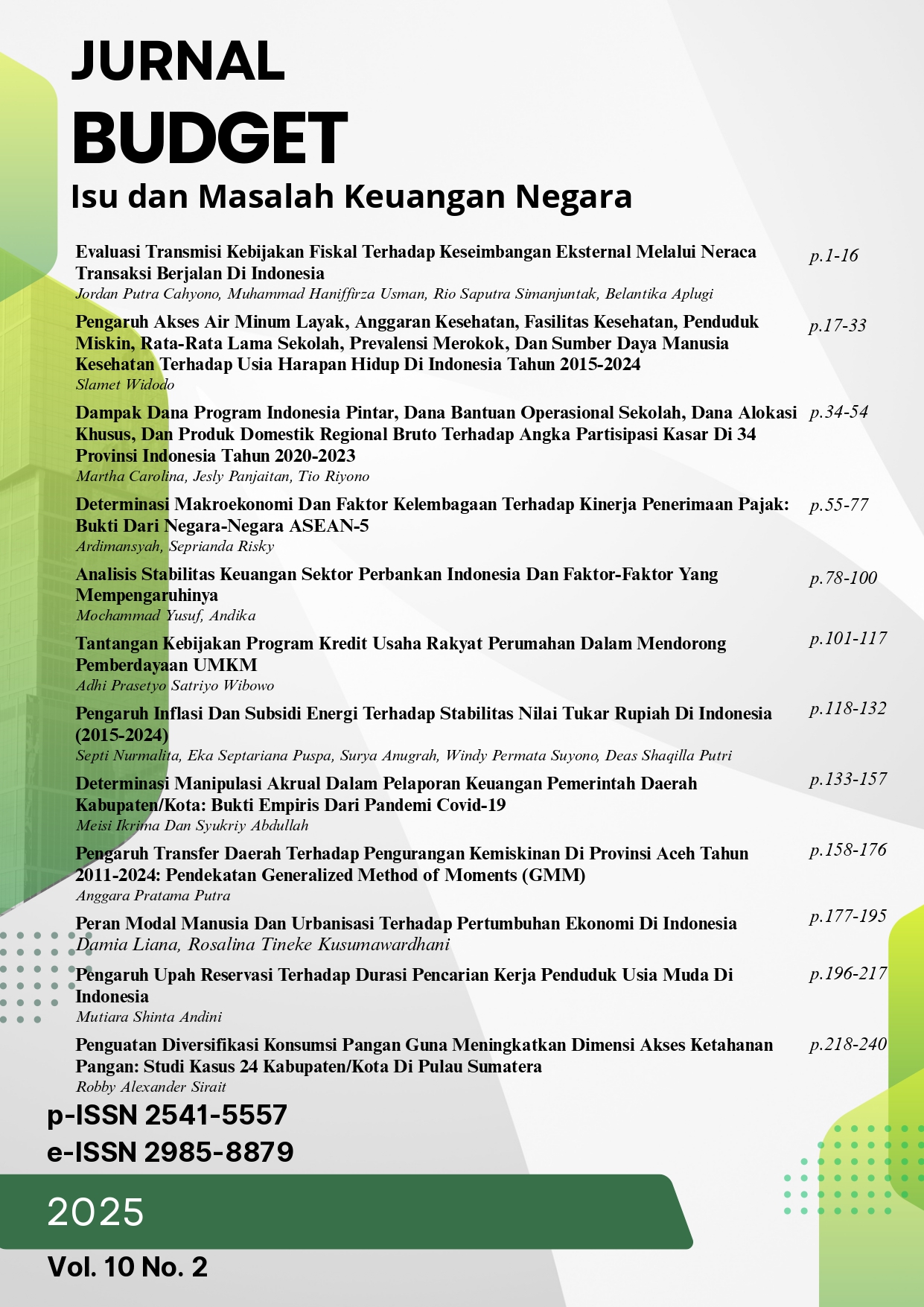
The Effect of Access to Suitable Drinking Water, Health Budget, Health Facilities, Poor Population, Average Years of Schooling, Smoking Prevalence, And Health Human Resources on Life Expectancy in Indonesia 2015-2024
Keywords:
Life Expectancy, Safe Drinking Water, Health Spending, Health Infrastructure, Poverty, Education, Smoking, Health WorkforceAbstract
Life expectancy (LE) represents a core dimension of human development and is a strategic benchmark for realizing Indonesia’s Golden Vision 2045, which aims to raise the national average to over 80 years. Yet, progress toward this goal continues to face obstacles such as inadequate access to clean water, disparities in the distribution of health facilities and personnel, persistent poverty, and high smoking prevalence. This research applies a quantitative design with provincial panel data to examine how several key factors—including safe drinking water access, public health spending, health infrastructure, poverty levels, average years of schooling, smoking prevalence, and health workforce availability—affect LE in Indonesia. The study seeks to identify the most influential determinants of longevity while offering policy-oriented insights. The results indicate that health infrastructure, education levels, and poverty rates are significant predictors of LE, whereas safe water access, health expenditure, smoking, and health workforce availability show limited statistical influence. These findings suggest that long-term investments in healthcare systems, education, and poverty reduction are vital to accelerate improvements in life expectancy and achieve the 2045 development agenda.
References
Adebayo, A. S., & Okafor, C. J. (2024). Public health expenditure and life expectancy in Nigeria. Journal of Economics and Allied Research, 9(1), 112–128.
Bashir, S., Kishwar, S., Nasir, M., & Ali, S. (2024). Socioeconomic inequalities in out-of-pocket and catastrophic health expenditures in Pakistan. International Journal of Public Health, 69, 1607313. https://doi.org/10.3389/ijph.2024.1607313
Das, T., & Guha, P. (2024). The puzzle of public health expenditure and healthcare infrastructure in India: An empirical investigation, Regional Science Policy & Practice, 16 (2), https://doi.org/10.1111/rsp3.12710
Dieleman, J. L., Templin, T., Sadat, N., Reidy, P., Chapin, A., Foreman, K., & Murray, C. J. L. (2016). National spending on health by source for 184 countries between 2013 and 2040. Health Policy and Planning, 31(7), 933–947. https://doi.org/10.1016/S0140-6736(16)30167-2
Ghozali, I., & Ratmono, D. (2017). Analisis multivariat dan ekonometrika dengan Eviews 10. Semarang: Badan Penerbit Universitas Diponegoro.
Handayani, T., & Nadjib, M. (2016). Analisis pembiayaan kesehatan daerah bersumber publik: Studi kasus di Dinas Kesehatan Kabupaten Bogor tahun 2012–2014. Jurnal Ekonomi Kesehatan Indonesia, 1(2). Article 5. https://doi.org/10.7454/eki.v1i2.1774
Heller, P. S. (2005). Understanding fiscal space (IMF Policy Discussion Paper No. 05/4). International Monetary Fund. https://doi.org/10.5089/9781451975635.003
Idaiani, S., Hendarwan, H., & Herawati, M. H. (2023). Disparities of health program information systems in indonesia: a cross-sectional indonesian health facility research 2019. International Journal of Environmental Research and Public Health, 20(5), 4384. https://doi.org/10.3390/ijerph20054384
Irawati, S. F., & Wibowo, A. (2021). The correlation between healthy houses and access to safe drinking water with the incidence of diarrhea in East Java in 2016. The Indonesian Journal of Public Health, 16(2), 264–272. https://doi.org/10.20473/ijph.v16i2.2021.264-272
Jha, P., & Peto, R. (2014). The impact of cigarette smoking on life expectancy between 1980 and 2010: A global perspective. Tobacco Control, 370(1), 60–69. https://doi.org/10.1136/tobaccocontrol-2015-052265
Karunarathne, M., Buddhika, P., Priyamantha, A., Mayogya, P., & Jayathilaka, R. (2025). Restoring life expectancy in low-income countries: The combined impact of COVID-19, health expenditure, GDP, and child mortality. BMC Public Health, 25(1), 1–22. https://doi.org/10.1186/s12889-025-22109-4
Khan, M. A., & Ahmad, R. (2024). Influence of government effectiveness, health expenditure, and sustainable development goals on life expectancy: Evidence from time series data. Sustainability, 16(4), 1789. https://doi.org/10.3390/su16146128
Kurniawan, M. K. S., Yasa, I. N. M., & Tisnawati, N. M. (2025). Determinant of life expectancy in Indonesia: Bibliometrics literature review. Malaysian Journal of Medical Research, 9(1), 30–41. https://doi.org/10.31674/mjmr.2025.v09i01.004
Kustanto, D. N. (2015). Dampak akses air minum dan sanitasi terhadap peningkatan kesejahteraan. Jurnal Sosek Pekerjaan Umum, 7(3), 173–179.
Marmot, M. (2005). Social determinants of health inequalities. The Lancet, 365(9464), 1099–1104. https://doi.org/10.1016/S0140-6736(05)71146-6
Marzuki, D. S., & Tahrim, N. (2024). Derajat kesehatan masyarakat. Uwais Inspirasi Indonesia.
Paramita, S.A., Yamazaki, C. & Koyama, H. (2020). Determinants of life expectancy and clustering of provinces to improve life expectancy: An ecological study in Indonesia. BMC Public Health, 20, 351. https://doi.org/10.1186/s12889-020-8408-3
Penchansky, R., & Thomas, J. W. (1981). The concept of access: Definition and relationship to consumer satisfaction. Medical Care, 19(2), 127–140. https://doi.org/10.1097/00005650-198102000-00001
Rajkumar, A. S., & Swaroop, V. (2008). Public spending and outcomes: Does governance matter? Journal of Development Economics, 86(1), 96–111. https://doi.org/10.1016/j.jdeveco.2007.08.003
Reitsma, M. B., Fullman, N., Ng, M., Salama, J. S., Abajobir, A., Abate, K. H., … Gakidou, E. (2017). Smoking prevalence and attributable disease burden in 195 countries and territories, 1990–2015: A systematic analysis. The Lancet Public Health, 2(7), e277–e289. https://doi.org/10.1016/S2468-2667(17)30165-2
Reitsma, M. B., Kendrick, P. J., & Lim, S. S. (2024). Forecasting the effects of smoking prevalence scenarios on years of life lost and life expectancy from 2022 to 2050: A systematic analysis for the Global Burden of Disease Study 2021. The Lancet Public Health, 9(2), e134–e145. https://doi.org/10.1016/S2468-2667(24)00166-X
Sachs, L., & Sachs, J. D. (2020). Health priorities for sustainable development. SSRN. https://doi.org/10.2139/ssrn.3753001
Setyadi, S., Kustanto, A., & Widiastuti, A. (2023). Life expectancy in Indonesia: The role of health infrastructure, political, and socioeconomic status. Iranian Economic Review, 27(3), 965–1005.
Shen, S., Ma, N., Wu, T., Xiong, Y., Yang, J., Wu, X., & Xiang, X. (2025). The association between all-cause mortality with drinking habits and water sources: A nationwide longitudinal study on Chinese elderly. Frontiers in Public Health, 13, 1673421.
Sudharsanan, N., & Ho, J. Y. (2020). Rural–urban differences in adult life expectancy in Indonesia: A parametric g-formula–based decomposition approach. Epidemiology, 31(3), 393–401. https://doi.org/10.1097/EDE.0000000000001172
Țarcă, V., Țarcă, E., & Moscalu, M. (2024). Social and economic determinants of life expectancy at birth in Eastern Europe. Healthcare, 12(11), 1148. https://doi.org/10.3390/healthcare12111148
World Health Organization. (2019). Drinking-water. https://www.who.int/news-room/fact-sheets/detail/drinking-water
Published
How to Cite
Issue
Section
License
Copyright (c) 2026 Slamet Widodo

This work is licensed under a Creative Commons Attribution-NonCommercial-ShareAlike 4.0 International License.
Jurnal Budget is licensed under a Creative Commons Attribution-NonCommercial-ShareAlike 4.0 International License. Permissions beyond the scope of this license may be available at https://ejurnal.dpr.go.id/index.php/jurnalbudget/index.