
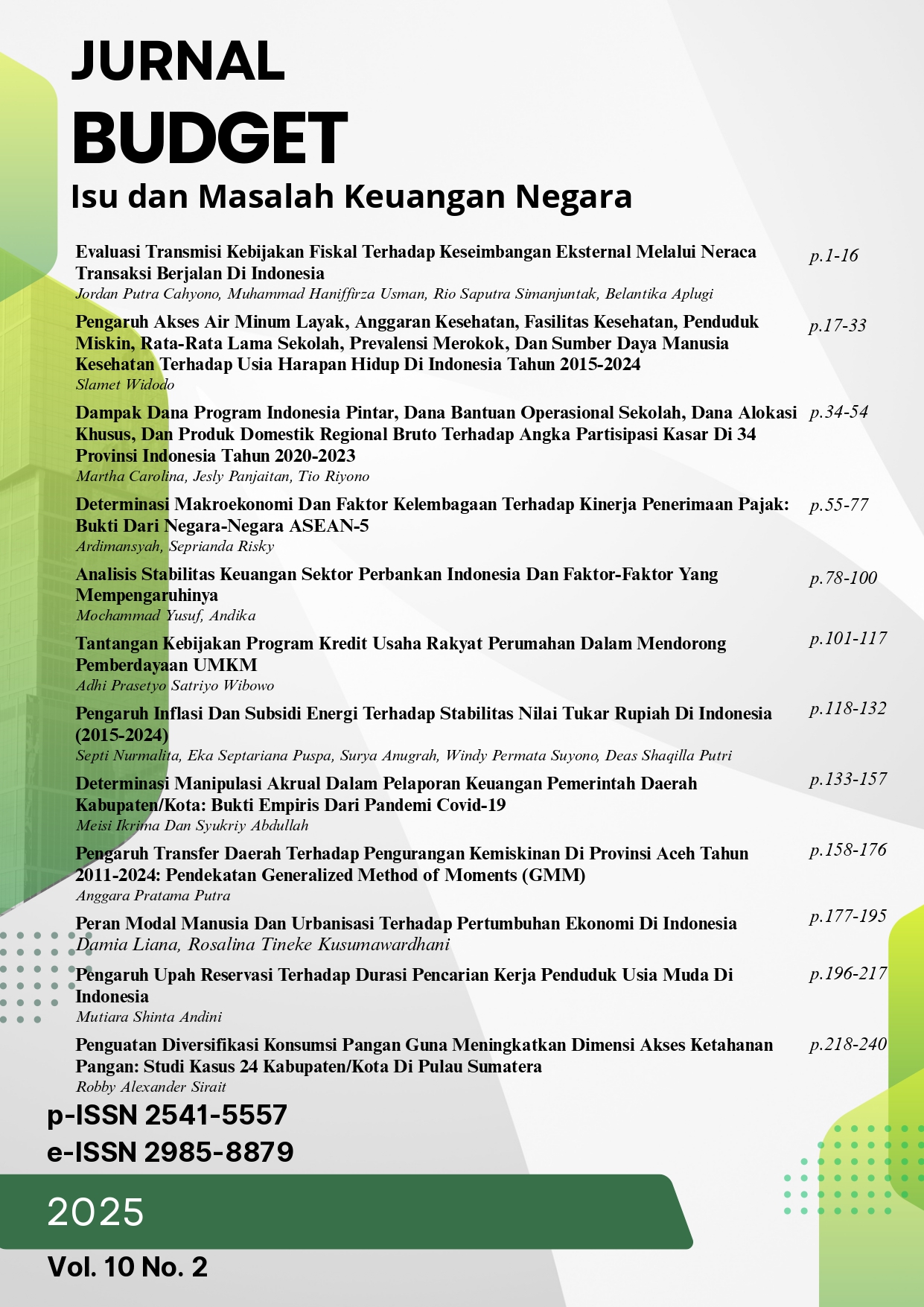
Analysis of Financial Stability In Indonesia’s Banking Sector And Its Determinant Factors
Kata Kunci:
Financial Stability, Inflation, Interest Rate, Money Supply, Exchange Rate, Error Correction Model (ECM)Abstrak
This study analyzes the financial stability of Indonesia’s banking sector and the macroprudential factors influencing it over the period 2014–2024. Monthly time-series data obtained from Bank Indonesia and the Financial Services Authority (OJK) were processed using the Engle–Granger Error Correction Model (ECM) to examine both short-run and long-run relationships between inflation, interest rates, exchange rates, and money supply in relation to financial stability, which is measured through the Bank Z-score. The empirical findings reveal that inflation exerts a significantly negative impact on financial stability, while the policy interest rate has a significantly positive long-term effect. The money supply demonstrates a positive influence in the long run but a negative one in the short run, whereas the exchange rate shows no statistically significant effect. These results highlight the importance of maintaining credible monetary policy and adaptive macroprudential coordination to safeguard the resilience of Indonesia’s banking sector amid persistent global economic uncertainties.
Referensi
Abasimel, N. A. (2023). Islamic Banking and Economics: Concepts and Instruments, Features, Advantages, Differences from Conventional Banks, and Contributions to Economic Growth. Journal of the Knowledge Economy, 14(2), 1923–1950. https://doi.org/10.1007/s13132-022-00940-z
Abuselidze, G. (2021). The Impact of Banking Competition on Economic Growth and Financial Stability: An Empirical Investigation. European Journal of Sustainable Development, 10(1), 203. https://doi.org/10.14207/ejsd.2021.v10n1p203
Acharya, V. V., Imbierowicz, B., Steffen, S., & Teichmann, D. (2020). Does the lack of financial stability impair the transmission of monetary policy? Journal of Financial Economics, 138(2), 342–365. https://doi.org/10.1016/j.jfineco.2020.06.011
Afandi, C. I., Bahri, S., & Hatib, M. (2024). Tren Terbaru Dalam Ekonomi Keuangan: Menjelajahi Dinamika Pasar Global Dan Lokal Di Indonesia. Ekomadania: Journal of Islamic Economic and Social, 8(1), 15–39.
Ahiadorme, J. W. (2022). Research in Economics Monetary policy in search of macroeconomic stability and inclusive growth. Research in Economics, 76(4), 308–324. https://doi.org/10.1016/j.rie.2022.08.002
Aklin, M., Arias, E., & Gray, J. (2022). Inflation concerns and mass preferences over exchange‐rate policy. Economics & Politics, 34(1), 5–40. https://doi.org/10.1111/ecpo.12176
Ali Mustafa, J. (2024). From innovation to stability: Evaluating the ripple influence of digital payment systems and capital adequacy ratio on a bank’s Z-score. Banks and Bank Systems, 19(3), 67–79. https://doi.org/10.21511/bbs.19(3).2024.07
Allen, W. A., & Wood, G. (2006). Defining and achieving financial stability. Journal of Financial Stability, 2(2), 152–172. https://doi.org/10.1016/j.jfs.2005.10.001
Andrei, D., & Hasler, M. (2025). Investor learning about monetary-policy transmission and the stock market. Journal of Financial Economics, 173, 104154. https://doi.org/10.1016/j.jfineco.2025.104154
Basu Dev Lamichhane. (2022). Ensuring Economic Stability through Liquidity Management in the Banking Sectors of Nepal. Interdisciplinary Journal of Management and Social Sciences, 3(2), 9–22. https://doi.org/10.3126/ijmss.v3i2.50258
Bayraktar, N. (2022). Economic Policies and Their Impacts on Growth (pp. 267–287). https://doi.org/10.1007/978-3-030-94672-2_16
Bhamra, H. S., Dorion, C., Jeanneret, A., & Weber, M. (2023). High Inflation: Low Default Risk and Low Equity Valuations. The Review of Financial Studies, 36(3), 1192–1252. https://doi.org/10.1093/rfs/hhac021
Borio, C. (2005). Monetary and Financial Stability: So Close and Yet So Far? National Institute Economic Review, 192, 84–101. https://doi.org/10.1177/002795010519200109
Borio, C. E. V, Farag, M., & Zampolli, F. (2023). Tackling the fiscal policy-financial stability nexus. Bank for International Settlements, Monetary and Economic Department.
Boyd, J. H., & Runkle, D. E. (1993). Size and performance of banking firms. Journal of Monetary Economics, 31(1), 47–67. https://doi.org/10.1016/0304-3932(93)90016-9
Bressler, S. L., & Seth, A. K. (2010). Wiener – Granger Causality : A well established methodology. NeuroImage. https://doi.org/10.1016/j.neuroimage.2010.02.059
Çelik, B. S. (2024). Is There a Relationship between Financial Stability and Macroeconomic Variables? (pp. 185–206). https://doi.org/10.4018/979-8-3693-5508-4.ch007
Chen, W., & Phelan, G. (2023a). Should monetary policy target financial stability? Review of Economic Dynamics, 49, 181–200. https://doi.org/10.1016/j.red.2022.08.002
Chen, W., & Phelan, G. (2023b). Should monetary policy target financial stability? Review of Economic Dynamics, 49(2023), 181–200. https://doi.org/10.1016/j.red.2022.08.002
Damane, M., & Ho, S.-Y. (2024). Effects of financial inclusion on financial stability: evidence from ssa countries. Munich Personal RePEc Archieve, 1.
Dargahi, H., & Hadian, M. (2022). Oil shocks, financial stability and implementing macroeconomics and macro‐prudential policies in an oil‐exporting economy. International Journal of Finance & Economics, 27(2), 2481–2496. https://doi.org/10.1002/ijfe.2282
Dickey, D. A., & Fuller, W. A. (2012). Distribution of the Estimators for Autoregressive Time Series with a Unit Root D. Journal of the American Statistical Association, 74(3), 37–41.
Dienillah, A. A., & Anggraeni, L. (2016). Dampak Inklusi Keuangan Terhadap Stabilitas Sistem Keuangan Di Asia. Buletin Ekonomi Moneter Dan Perbankan, 18(4), 409–430. https://doi.org/10.21098/bemp.v18i4.574
Ehigiamusoe, K. U., & Samsurijan, M. S. (2021). What matters for finance‐growth nexus? A critical survey of macroeconomic stability, institutions, financial and economic development. International Journal of Finance & Economics, 26(4), 5302–5320. https://doi.org/10.1002/ijfe.2066
Elsayed, A. H., Naifar, N., & Nasreen, S. (2023). Financial stability and monetary policy reaction: Evidence from the GCC countries. Quarterly Review of Economics and Finance, 87, 396–405. https://doi.org/10.1016/j.qref.2022.03.003
Ender, M., & Neuhofer, C. (2021). IMPLICATIONS OF LOW INTEREST RATES ON BANK PROFITABILITY AND RISK-TAKING. Journal of Financial Management, Markets and Institutions, 09(01), 2150003. https://doi.org/10.1142/S2282717X21500031
Engle, R. F., & Granger, C. W. J. (1987). Co-Integration and Error Correction : Representation, Estimation, and Testing. Econometrica, 55(2), 251–276.
Fazal, T. J., Gulzar, S., & Naz, S. A. (2025). Banking sector development and economic growth: empirical evidence from Pakistan in the context of COVID-19. Journal of Islamic Accounting and Business Research. https://doi.org/10.1108/JIABR-05-2024-0187
Georgiadis, G., & Zhu, F. (2021). Foreign-currency exposures and the financial channel of exchange rates: Eroding monetary policy autonomy in small open economies? Journal of International Money and Finance, 110, 102265. https://doi.org/10.1016/j.jimonfin.2020.102265
Gujarati. D. N. (2004). Basic Econometrics (4th edition, Ed.). McGraw-Hill Companies.
Haerunnisa, H. (2025). Indonesia’s Economic Resilience Assessment During Israel-Iran Conflict and Global Financial System Crisis: Evaluasi Ketahanan Ekonomi Indonesia Selama Konflik Israel-Iran dan Krisis Sistem Keuangan Global. Journal of Statecraft, Politics, and Geopolitics, 1(1), 1–10.
Harun, C. A., & Gunadi, I. (2022). Financial Stability and Systemic Risk. In Central Bank Policy Mix: Issues, Challenges, and Policy Responses (pp. 73–89). Springer Nature Singapore. https://doi.org/10.1007/978-981-16-6827-2_5
Hudaya, A., & Firmansyah, F. (2023a). Financial stability in the Indonesian monetary policy analysis. Cogent Economics & Finance, 11(1). https://doi.org/10.1080/23322039.2023.2174637
Hudaya, A., & Firmansyah, F. (2023b). Financial stability in the Indonesian monetary policy analysis. Cogent Economics and Finance, 11(1). https://doi.org/10.1080/23322039.2023.2174637
Iorember, P. T., Jelilov, G., Alymkulova, N., & Yua, P. M. (2022). Reconsidering the nexus between monetary policy and economic growth in Nigeria: The role of interest rate, money supply, and financial inclusion. International Social Science Journal, 72(244), 339–351. https://doi.org/10.1111/issj.12324
Ivanova, N., Popova, S., & Styrin, K. (2025). Bank market power and monetary policy transmission: Evidence from loan-level data. Emerging Markets Review, 66, 101280. https://doi.org/10.1016/j.ememar.2025.101280
Jiang, Y., Li, C., Zhang, J., & Zhou, X. (2019a). Financial Stability and Sustainability under the Coordination of Monetary Policy and Macroprudential Policy: New Evidence from China. Sustainability, 11(6), 1616. https://doi.org/10.3390/su11061616
Jiang, Y., Li, C., Zhang, J., & Zhou, X. (2019b). Financial stability and sustainability under the coordination of monetary policy and macroprudential policy: New evidence from China. Sustainability (Switzerland), 11(6). https://doi.org/10.3390/su11061616
Juhro, S. M., Syarifuddin, F., & Sakti, A. (2025). Inflation, Exchange Rates, and Interest Rates. In Inclusive Welfare (pp. 323–347). Springer Nature Singapore. https://doi.org/10.1007/978-981-96-0051-9_10
Кishibayeva, B., Jaxybekova, G., Nurgalieva, G., Wada, I., & Faizulayev, A. (2023). Determinants of bank capital adequacy: International evidence from G7 countries. International Social Science Journal, 73(249), 737–752. https://doi.org/10.1111/issj.12401
Koudalo, Y. M. A., & Toure, M. (2023). Does financial inclusion promote financial stability? Evidence from Africa. Cogent Economics and Finance, 11(2). https://doi.org/10.1080/23322039.2023.2225327
Lazopoulos, I., & Gabriel, V. (2019). Policy mandates and institutional architecture. Journal of Banking & Finance, 100, 122–134. https://doi.org/10.1016/j.jbankfin.2019.01.006
Magubane, K., & Nzimande, N. P. (2024). A Structural Vector Autoregression Exploration of South Africa’s Monetary and Macroprudential Policy Interactions. Economies, 12(10), 278. https://doi.org/10.3390/economies12100278
Mishkin, F. S. (1999). Global Financial Instability: Framework, Events, Issues. Journal of Economic Perspectives, 13(4), 3–20. https://doi.org/10.1257/jep.13.4.3
Mughal, N., Kashif, M., Arif, A., Guerrero, J. W. G., Nabua, W. C., & Niedbała, G. (2021). Dynamic effects of fiscal and monetary policy instruments on environmental pollution in ASEAN. Environmental Science and Pollution Research, 28(46), 65116–65126. https://doi.org/10.1007/s11356-021-15114-8
Oanh, T. T. K., Van, L. T. T., & Dinh, L. Q. (2023a). Relationship between financial inclusion, monetary policy and financial stability: An analysis in high financial development and low financial development countries. Heliyon, 9(6), e16647. https://doi.org/10.1016/j.heliyon.2023.e16647
Oanh, T. T. K., Van, L. T. T., & Dinh, L. Q. (2023b). Relationship between financial inclusion, monetary policy and financial stability: An analysis in high financial development and low financial development countries. Heliyon, 9(6), e16647. https://doi.org/10.1016/j.heliyon.2023.e16647
Ozili, P. K., & Iorember, P. T. (2024). Financial stability and sustainable development. International Journal of Finance & Economics, 29(3), 2620–2646. https://doi.org/10.1002/ijfe.2803
Pham, T. T., Dao, L. K. O., & Nguyen, V. C. (2021). The determinants of bank’s stability: a system GMM panel analysis. Cogent Business and Management, 8(1). https://doi.org/10.1080/23311975.2021.1963390
Priyatna, H. N., Suryadi, I., & Ersanti. (2025). Facing Global Inflation: Economic Strategies to Strengthen People’s Purchasing Power. MSJ : Majority Science Journal, 3(1), 73–81. https://doi.org/10.61942/msj.v3i1.312
Rahman, M. M., Rahman, M., & Masud, Md. A. K. (2023). Determinants of the Cost of Financial Intermediation: Evidence from Emerging Economies. International Journal of Financial Studies, 11(1), 11. https://doi.org/10.3390/ijfs11010011
Sanderson, A., Jeke, L., Manenge, R., Mukarati, J., & Le Roux, P. (2025). Bank Stability and Its Determinants in the SADC Region. WSEAS TRANSACTIONS ON BUSINESS AND ECONOMICS, 22, 1121–1132. https://doi.org/10.37394/23207.2025.22.92
Siddik, M. N. A., & Kabiraj, S. (2018). Does financial inclusion induce financial stability? Evidence from cross-country analysis. Australasian Accounting, Business and Finance Journal, 12(1), 33–46. https://doi.org/10.14453/aabfj.v12i1.3
Studentmund. (2016). Using Econometrics: A Practical Guide (7th edition). Pearson.
Sui, J., Liu, B., Li, Z., & Zhang, C. (2022). Monetary and macroprudential policies, output, prices, and financial stability. International Review of Economics and Finance, 78(November 2021), 212–233. https://doi.org/10.1016/j.iref.2021.11.010
Wang, O. (2025). Banks, Low Interest Rates, and Monetary Policy Transmission. The Journal of Finance, 80(3), 1379–1416. https://doi.org/10.1111/jofi.13436
Wooldridge, J. M. (2013). Introductory Econometrics: A Modern Approach. In Tolerance Analysis of Electronic Circuits Using MATHCAD (5th edition). South Western Cengage Learning. https://doi.org/10.1201/9781315215402-43
Diterbitkan
Cara Mengutip
Terbitan
Bagian
Lisensi
Hak Cipta (c) 2026 Mochammad Yusuf, Andika

Artikel ini berlisensiCreative Commons Attribution-NonCommercial-ShareAlike 4.0 International License.
Jurnal Budget is licensed under a Creative Commons Attribution-NonCommercial-ShareAlike 4.0 International License. Permissions beyond the scope of this license may be available at https://ejurnal.dpr.go.id/index.php/jurnalbudget/index.

 Pernyataan Etika