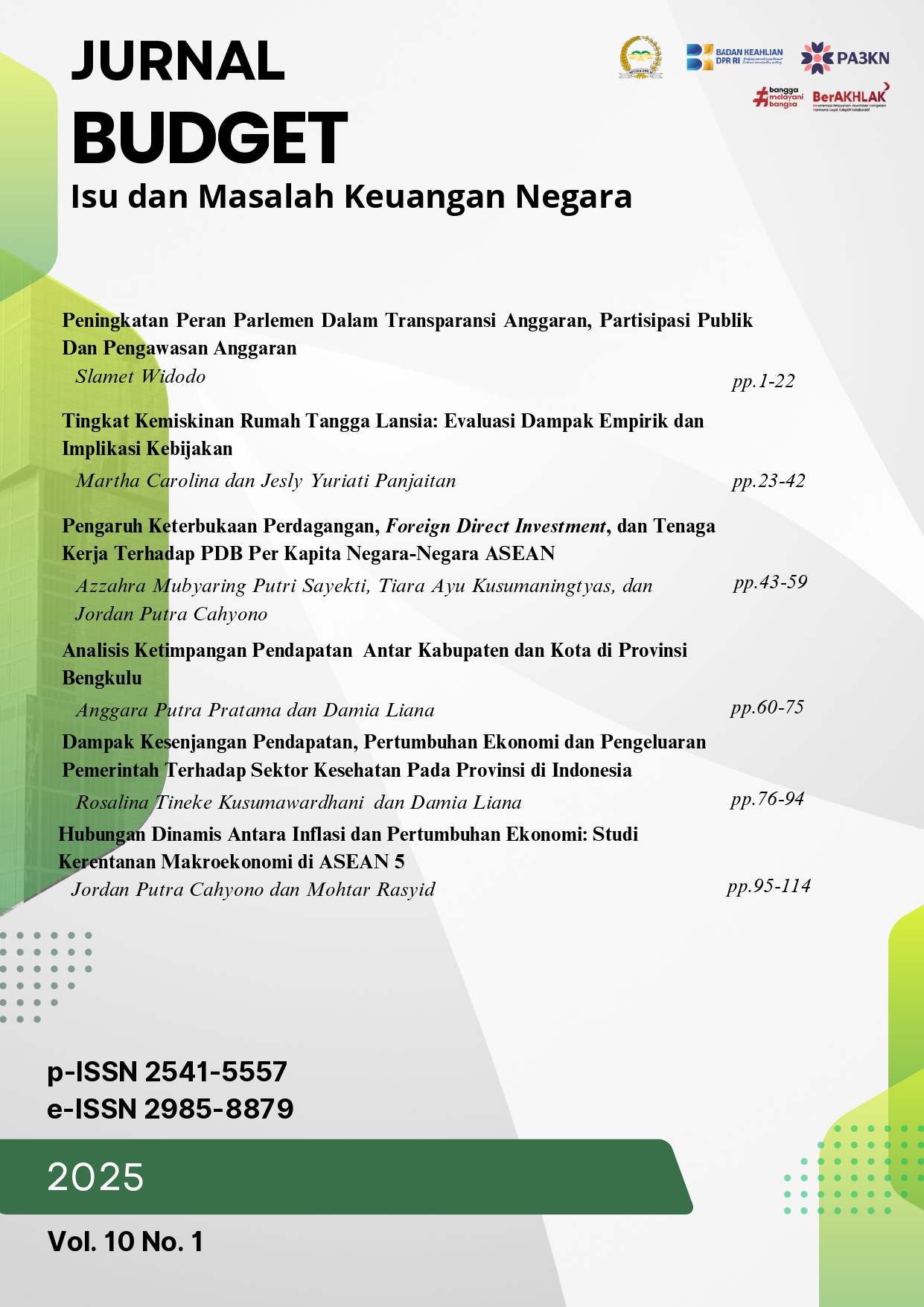
Effect of Trade Openness, Foreign Direct Investment, and Labor on GDP Per Capita of ASEAN Countries
Keywords:
ASEAN, foreign direct investments, GDP per Capita, Labor, Trade OpennessAbstract
Trade openness has been widely studied for its impact on economic growth, yet its specific role in ASEAN countries, with diverse levels of integration and trade policies, remains underexplored. This study examines the effects of trade openness, foreign direct investment (FDI), and labor on GDP per capita in ASEAN countries using panel data from 2008 to 2022. Employing a fixed-effect regression model with Driscoll-Kraay standard errors, the findings reveal that trade openness has a significant yet negative impact on GDP per capita, while FDI and labor exhibit significant positive effects. This study recommends ASEAN countries to diversify exports, reduce dependency on foreign inputs, strengthen local industries, attract high-quality FDI, and improve labor capacity through education and vocational training. Strengthening intraregional trade cooperation is also crucial to reduce development disparities and promoting inclusive growth.
References
Abdallah, A. B. (2024). The relationship between trade openness, foreign direct investment inflows, and economic growth in Middle East and North of Africa region: Autoregressive distributed lag model vs. vector error correction model. Journal of the Knowledge Economy, 15(1), 1118–1141. https://doi.org/10.1007/s13132-023-01099-x
Adha, R., Hong, C. Y., Yang, S. F., & Muzayyanah, S. (2024). Re-unveiling the energy efficiency impact: Paving the way for sustainable growth in ASEAN countries. Sustainable Development, 32(5), 5812–5824. https://doi.org/10.1002/sd.3005
Agrawal, G., & Khan, M. A. (2011). Impact of FDI on GDP: A comparative study of China and India. International Journal of Business and Management, 6(10). https://doi.org/10.5539/ijbm.v6n10p71
Alam, A., Arshad, M. U., & Rajput, W. (2013). Relationship of labor productivity, foreign direct investment and economic growth: Evidence from OECD countries. Journal of Business and Management Sciences, 1(6), 133–138. https://doi.org/10.12691/jbms-1-6-3
Athukorala, P., & Kohpaiboon, A. (2018). Global value chains and export performance in the crisis era: Evidence from ASEAN countries. The World Economy, 41(3), 656–670.
Adu-Gyamfi, G., Nketiah, E., Obuobi, B., & Adjei, M. (2020). Trade openness, inflation and GDP growth: Panel data evidence from nine West Africa countries. Open Journal of Business and Management, 8(1), 314–328. https://doi.org/10.4236/ojbm.2020.81019
Belloumi, M., & Alshehry, A. (2020). The impact of international trade on sustainable development in Saudi Arabia. Sustainability, 12(13). https://doi.org/10.3390/su12135421
Bloom, D. E., Canning, D., & Sevilla, J. (2003). The demographic dividend: A new perspective on the economic consequences of population change. RAND Corporation.
Breuer, M., & Dehaan, E. (2024). Using and interpreting fixed effects models. Journal of Accounting Research, 62(4), 1183–1226. https://doi.org/10.1111/1475-679X.12559
Chen, S. (2024). The impact of green trade barriers on China’s photovoltaic products exports to ASEAN. Frontiers in Environmental Science, 12, 1459950. https://doi.org/10.3389/fenvs.2024.1459950
Chibalamula, H. C., Evans, Y., Kachelo, M., & Bamwesigye, D. (2023). The effect of foreign direct investment and trade openness on economic growth: Evidence from five African countries. Agris On-Line Papers in Economics and Informatics, 15(1), 35–46. https://doi.org/10.7160/aol.2023.150103
Costinot, A., Donaldson, D., & Komunjer, I. (2024). Revisiting Ricardo: Comparative Advantage in Global Value Chains. Journal of International Economics, 145, 103–122.
de Almeida, E. O., Cateia, J. V., Barbosa, W., & de Freitas, C. A. (2024). Trade liberalization and total factor productivity in Brazil: A VECM modeling. PLOS ONE, 19(11), e0312599. https://doi.org/10.1371/journal.pone.0312599
Driscoll, J. C., & Kraay, A. C. (1998). Consistent covariance matrix estimation with spatially dependent panel data. Review of Economics and Statistics, 80(4), 549–560. http://www.jstor.org/stable/2646837
Emami, N., Miatto, A., Gheewala, S., Soonsawad, N., Nguyen, T. C., Chiu, A. S. F., Gue, I. H., Martinico-Perez, M. F., Vilaysouk, X., & Schandl, H. (2024). Measuring progress toward a circular economy of the ASEAN Community. Journal of Industrial Ecology. https://doi.org/10.1111/jiec.13597
Hafizhy, M. N., & Sukarniati, L. (2024). Determinasi pertumbuhan ekonomi di 8 negara ASEAN [Determinants of economic growth in 8 ASEAN countries]. Socius: Jurnal Penelitian Ilmu-Ilmu Sosial, 2, 136. https://doi.org/10.5281/zenodo.13348755
Herrendorf, B., & Schoellman, T. (2015). Why is measured productivity so low in agriculture? Review of Economic Dynamics, 18(4), 1003–1028.
Hoang, T. K., & Le, Q. H. (2024). The impact of technical change on income inequality in Vietnam. Journal of Economics and Development, 26(4), 329–345. https://doi.org/10.1108/JED-03-2024-0087
Ifa, K., Indrianasari, N. T., & Liyundira, F. S. (2020). Keterbukaan perdagangan, inflasi, jumlah tenaga kerja dan pertumbuhan ekonomi di Indonesia [Trade openness, inflation, labor force, and economic growth in Indonesia]. OECONOMICUS Journal of Economics, 5(1), 10–23. https://doi.org/10.15642/oje.2020.5.1.10-23
Islam, M. S., Alsaif, S. S., & Alsaif, T. (2022). Trade openness, government consumption, and economic growth nexus in Saudi Arabia: ARDL cointegration approach. SAGE Open, 12(2). https://doi.org/10.1177/21582440221096661
Karahan, Ö., & Bayır, M. (2022). The effects of monetary policies on foreign direct investment inflows in emerging economies: Some policy implications for post-COVID-19. Future Business Journal, 8, Article 39. https://doi.org/10.1186/s43093-022-00152-6
Kumar, N., & Pradhan, J. P. (2020). FDI, Employment Generation, and Output Growth: Evidence from Manufacturing Industries in India. (jurnal tidak disebutkan volume/issue halaman; tambahkan bila tersedia)
Lee, J., & Park, D. (2021). ASEAN economic integration: Divergent outcomes for member states. Journal of Asian Economics, 74, 101303.
Liu, H., Islam, M. A., Khan, M. A., Hossain, M. I., & Pervaiz, K. (2020). Does financial deepening attract foreign direct investment? Fresh evidence from panel threshold analysis. Research in International Business and Finance, 53, 101198. https://doi.org/10.1016/j.ribaf.2020.101198
López-Cabarcos, M. Á., Vázquez-Rodríguez, P., & Quiñoá-Piñeiro, L. M. (2022). An approach to employees’ job performance through work environmental variables and leadership behaviours. Journal of Business Research, 140, 361–369. https://doi.org/10.1016/j.jbusres.2021.11.006
Mankiw, N. G., Romer, D., & Weil, D. N. (1992). A contribution to the empirics of economic growth. Quarterly Journal of Economics, 107(2), 407–437.
Müller, S. (2023). Human Capital Elasticity in Post-Pandemic Production Functions. Economic Modelling, 118, 106–122. https://doi.org/10.1016/j.econmod.2022.106122
Monyela, M. N., & Saba, C. S. (2024). Trade openness, economic growth and economic development nexus in South Africa: A pre- and post-BRICS analysis. Humanities and Social Sciences Communications, 11(1), 1–18. https://doi.org/10.1057/s41599-024-03604-2
Nam, H. J., & Ryu, D. (2024). Does trade openness promote economic growth in developing countries? Journal of International Financial Markets, Institutions and Money, 93, 101985. https://doi.org/10.1016/j.intfin.2024.101985
Nguyen, T. & Tran, L. (2023). “FDI, Institutional Quality, and Economic Growth in Vietnam: A Panel Data Approach.” Journal of Southeast Asian Economies, 40(2), 115–130.
Nguyen, T. A., & Suryadarma, D. (2024). Regional disparities in ASEAN trade-led growth: The convergence paradox. *Journal of Southeast Asian Economies*, *41*(2), 215–234. https://doi.org/10.1355/jae.41.2.215
Nygård, O. E., & Thoresen, T. O. (2023). Controlling for fixed effects in studies of income underreporting. European Journal of Law and Economics. https://doi.org/10.1007/s10657-023-09769-6
Oladimeji, M. S., & Ibrahim, O. M. (2017). The effect of international business on SMEs growth in Nigeria. Journal of Competitiveness, 9(3), 67–80. https://doi.org/10.7441/joc.2017.03.05
Sari, F., & Dawood, T. C. (2022). Pengaruh foreign direct investment, remitansi, kredit, keterbukaan perdagangan dan pengeluaran konsumsi pemerintah terhadap PDB ASEAN [The effect of FDI, remittances, credit, trade openness, and government consumption on ASEAN GDP]. Jurnal Ilmiah Mahasiswa Ekonomi Pembangunan (JIM EKP), 7, 287–296.
Sok, S., & Ouch, C. (2020). Cambodia’s economic integration in ASEAN: Challenges and opportunities. Journal of Southeast Asian Economies, 37(2), 189–205.
Sugiyono. (2013). Metode penelitian kuantitatif, kualitatif dan R&D [Quantitative, qualitative, and R&D research methods]. Alfabeta.
Suriya, P. & Thanaporn, C. (2023). “FDI Spillovers to Skilled and Unskilled Labor Markets in Thailand.” Asian Journal of Economic Modelling, 11(3), 202–220.
Temple, J. (1999). The new growth evidence. Journal of Economic Literature, 37(1), 112–156.
UNCTAD. (2022). Trade and development report 2022. https://unctad.org/publication/trade-and-development-report-2022
Widodo, R. & Prasetyo, A. (2022). “Trade Openness and Sectoral Growth in Indonesia: Evidence from a Fixed-Effects Model.” Bulletin of Indonesian Economic Studies, 58(1), 45–63.
Zhang, Y. (2015). ASEAN-China trade relations: Opportunities and challenges. Journal of Contemporary Asia, 45(4), 654–677.
Published
How to Cite
Issue
Section
License
Copyright (c) 2026 Azzahra Mubyaring Putri Sayekti, Tiara Ayu Kusumaningtyas, Jordan Putra Cahyono

This work is licensed under a Creative Commons Attribution-NonCommercial-ShareAlike 4.0 International License.
Jurnal Budget is licensed under a Creative Commons Attribution-NonCommercial-ShareAlike 4.0 International License. Permissions beyond the scope of this license may be available at https://ejurnal.dpr.go.id/index.php/jurnalbudget/index.