
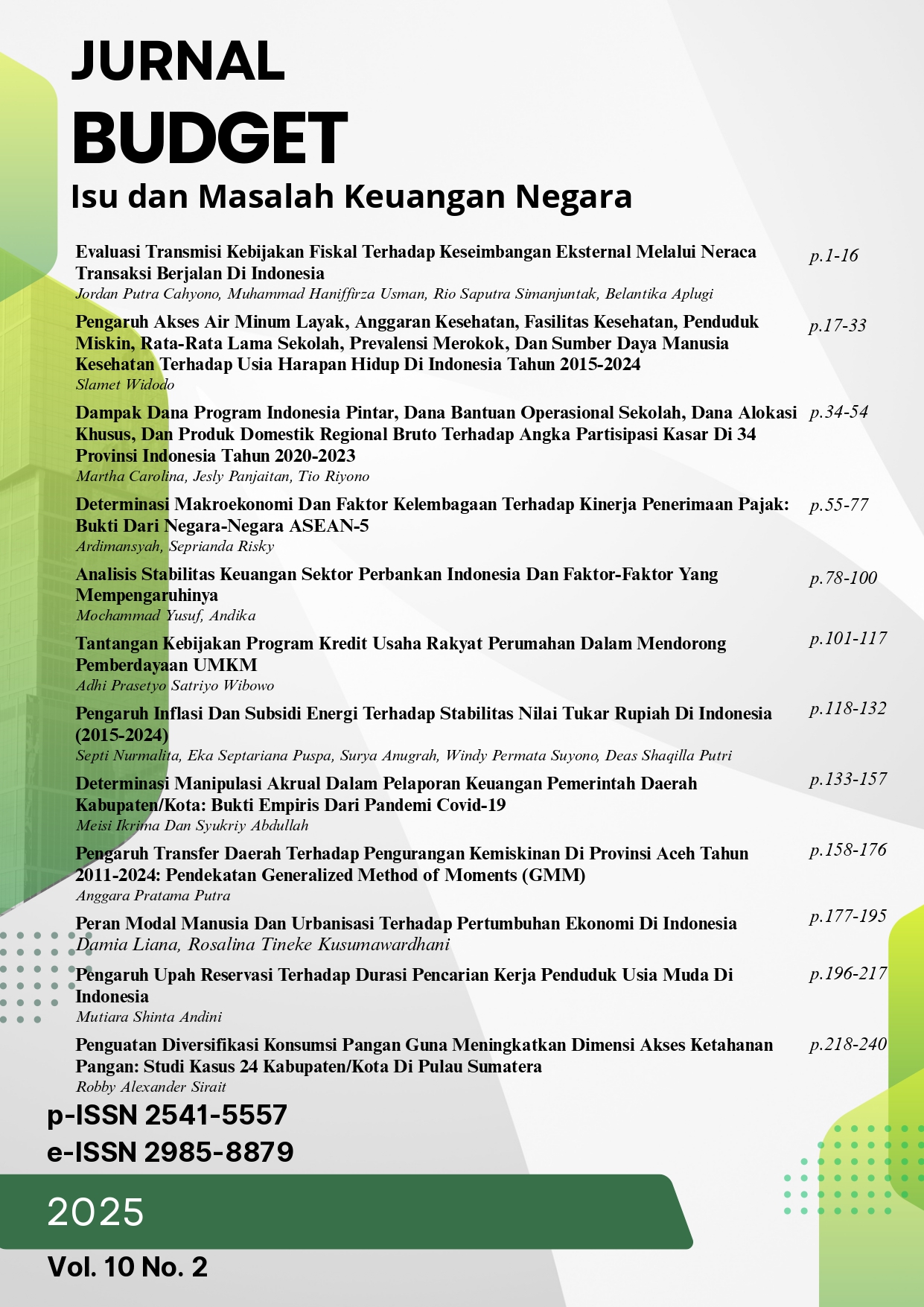
Evaluation Of Fiscal Policy Transmission On External Balance Through The Current Account Balance In Indonesia
Kata Kunci:
fiscal policy, budget shocks, current account balance, macroeconomic stability, IndonesiaAbstrak
This study examines the impact of government budget shocks on the current account balance (CAB) in Indonesia, addressing the gap in understanding the short-term effects of fiscal policy on external balance. Using annual time-series data from 1981 to 2024, the research applies an Ordinary Least Squares (OLS) model to analyze the relationship between government expenditure and CAB. Key findings reveal that government consumption expenditure (GGFCE) has a significant positive effect on CAB, with a coefficient of 0.136, suggesting that a 1% increase in government spending improves the current account balance by 0.136% of GDP. Conversely, gross fixed capital formation (GFCF) has a significant negative effect on CAB with a coefficient of -0.181, indicating that higher domestic investment, reliant on imported capital goods, worsens the current account deficit. These findings highlight the importance of balancing fiscal expansion with strategic spending. Theoretical implications suggest that fiscal policy's impact on the current account is mediated by both domestic consumption and trade flows. From a policy perspective, the study recommends that Indonesia’s fiscal strategy focus on export-oriented sectors, such as manufacturing and renewable energy, while controlling non-productive consumption and intensive imports. This approach can strengthen Indonesia’s economic resilience to external shocks and improve its external balance.
Referensi
Afonso, A., & Opoku, P. K. (2023). The nexus between fiscal and current account imbalances in OECD economies. Applied Economics, 55(13), 1389–1406. https://doi.org/10.1080/00036846.2022.2097188
Altayligil, Y. B., & Çetrez, M. (2020). Macroeconomic, institutional and financial determinants of current account balances: a panel data assessment. Journal of Economic Structures, 9(1), 1–23. https://doi.org/10.1186/S40008-020-00225-1/FIGURES/4
Aromí, J. D. (2021). Large Current Account Deficits and Neglected Vulnerabilities. IMF Economic Review, 69(4), 597–623. https://doi.org/10.1057/S41308-021-00137-5/TABLES/11
Badinger, H., Fichet de Clairfontaine, A., & Reuter, W. H. (2017). Fiscal Rules and Twin Deficits: The Link between Fiscal and External Balances. The World Economy, 40(1), 21–35. https://doi.org/10.1111/TWEC.12427
Banerjee, J. J. (2024). Inflationary oil shocks, fiscal policy, and debt dynamics: New evidence from oil-importing OECD economies. Energy Economics, 130. https://doi.org/10.1016/J.ENECO.2023.107249
Banerjee, J. J. (2025). UK fiscal policy and external balance under Bretton Woods: Twin deficits or distant relatives? Economic History Review, 78(2), 583–612. https://doi.org/10.1111/EHR.13352
Basuki, A. T. (2025). Uncovering the Macroeconomic Factors Driving Household Consumption in Indonesia: A Short-Term and Long-Term Analysis. Riwayat: Educational Journal of History and Humanities, 8(2), 1434–1447. https://doi.org/10.24815/JR.V8I2.45420
Beaudry, P., Hou, C., & Portier, F. (2024). Monetary Policy When the Phillips Curve Is Quite Flat. American Economic Journal: Macroeconomics, 16(1), 1–28. https://doi.org/10.1257/MAC.20220088
Camba-Crespo, A., García-Solanes, J., & Torrejón-Flores, F. (2022). Current-Account Imbalances, Real Exchange-Rate Misalignments, and Output Gaps. Economics, 16(1), 57–72. https://doi.org/10.1515/ECON-2022-0021
Dalla, V., Giraitis, L., & Phillips, P. C. B. (2022). Robust Tests For White Noise and Cross-Correlation. Econometric Theory, 38(5), 913–941. https://doi.org/10.1017/S0266466620000341
Dvoskin, A., & Landau, M. T. (2024). Limits to Fiscal and Monetary Policy in Small Open Economies. Review of Political Economy, 36(5), 1915–1942. https://doi.org/10.1080/09538259.2023.2279162
Frenkel, J., Razin, A., & Yuen, C.-W. (1996). Fiscal policies and growth in the world economy.
Garg, B., & Paranavithana, H. (2024). Do Different Credit Flows Affect the Current Account Differently? Evidence from Emerging Economies. Emerging Markets Finance and Trade, 60(10), 2190–2203. https://doi.org/10.1080/1540496X.2024.2310027
Haidari, A., & Junejo, S. (2024). The Impact of Fiscal Policy on Economic Growth: Fresh Evidence From Malaysia. Cognizance Journal of Multidisciplinary Studies, 4(2), 314–336. https://doi.org/10.47760/COGNIZANCE.2024.V04I02.027
Indrawati, S. M., Satriawan, E., & Abdurohman. (2024). Indonesia’s Fiscal Policy in the Aftermath of the Pandemic. Bulletin of Indonesian Economic Studies, 60(1), 1–33. https://doi.org/10.1080/00074918.2024.2335967
Klein, M., & Linnemann, L. (2019). Macroeconomic Effects of Government Spending: The Great Recession was (Really) Different. Journal of Money, Credit and Banking, 51(5), 1237–1264. https://doi.org/10.1111/JMCB.12558
Klein Martins, G. (2025). Long-run Effects of Austerity: An Analysis of Size Dependence and Persistence in Fiscal Multipliers. Oxford Bulletin of Economics and Statistics, 87(2), 330–356. https://doi.org/10.1111/OBES.12646
Liu, H., & Ren, J. (2024). Do budget deficits cause current account deficits? a re-evaluation utilizing military expenditures as an instrumental variable. PLoS ONE, 19(10 October). https://doi.org/10.1371/JOURNAL.PONE.0311664
Moessner, R. (2025). Effects of inflation expectations on inflation. National Institute Economic Review. https://doi.org/10.1017/NIE.2024.24
Nashi, R., & Ouakil, H. (2025). Energy price shocks and current account balances: What role for economic structure, energy dependency and renewable energy development? Sustainable Futures, 9, 100402. https://doi.org/10.1016/J.SFTR.2024.100402
Ozkan, C., & Okay, N. (2024). Does Renewable Energy Convey Information to Current Account Deficit?: Evidence from OECD Countries. Sustainability 2024, Vol. 16, Page 8241, 16(18), 8241. https://doi.org/10.3390/SU16188241
Perdana, M. N. A., & Sugiyanto, F. (2021). Analysis of Budget Deficit Phenomenon and Current Account Deficit in Indonesia (1990-2019). Journal of Economic Development and Social Research, 1(1), 38–50. https://doi.org/10.14710/JEDSR.V1I1.12544
Sari, F. M., Astuti, A., Zamanda, D., Restu, F. P., & Fadilla, A. (2024). Kebijakan Fiskal dan Dampaknya Terhadap Perekonomian Indonesia. Journal of Economics, Assets, and Evaluation, 1(4), 1–10. https://doi.org/10.47134/JEAE.V1I4.231
Talha, E. A. (2025). Fiscal Reaction Function and Macroeconomic Shocks: Evidence from Developing Countries. https://doi.org/10.21203/RS.3.RS-7378610/V1
Varona, L., Gonzales, J. R., García, B., & Gismera, L. (2024). Economic growth and the foreign sector: Peru 1821–2020. Cambridge Journal of Economics, 48(6), 1051–1090. https://doi.org/10.1093/CJE/BEAE019
Zhu, H., & Yang, L. (2022). portfolio: A command for conducting portfolio analysis in Stata. Stata Journal, 22(4), 941–957. https://doi.org/10.1177/1536867X221141021
Diterbitkan
Cara Mengutip
Terbitan
Bagian
Lisensi
Hak Cipta (c) 2026 Jordan Putra Cahyono, Muhammad Haniffirza Usman, Rio Saputra Simanjuntak, Belantika Aplugi

Artikel ini berlisensiCreative Commons Attribution-NonCommercial-ShareAlike 4.0 International License.
Jurnal Budget is licensed under a Creative Commons Attribution-NonCommercial-ShareAlike 4.0 International License. Permissions beyond the scope of this license may be available at https://ejurnal.dpr.go.id/index.php/jurnalbudget/index.

 Pernyataan Etika