
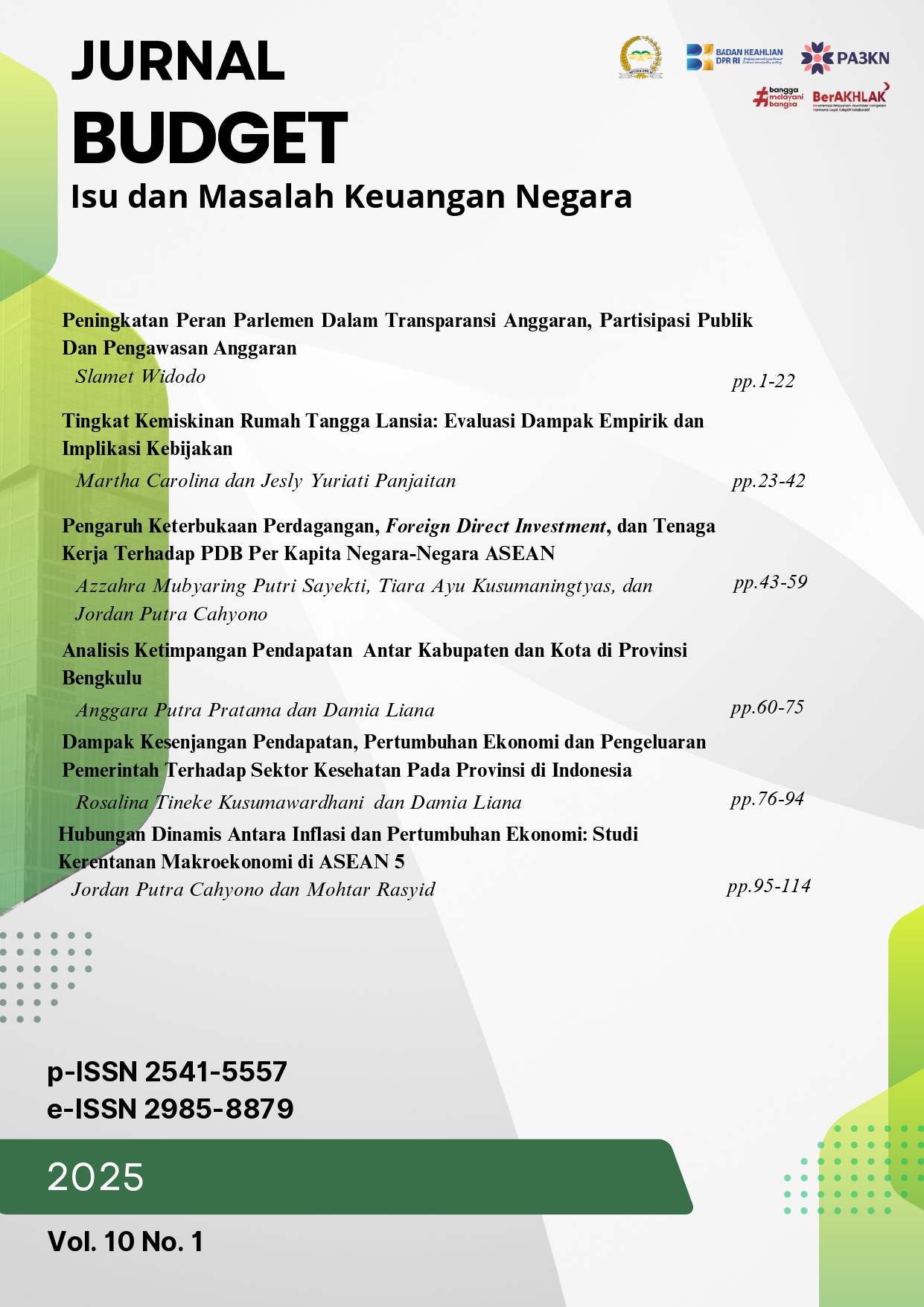
Dynamic Relationship Between Inflation and Economic Growth: A Study of Macroeconomic Vulnerability in Asean 5
Kata Kunci:
Inflation Threshold, macroeconomic resilience, ASEAN-5, Nonlinear analysis, Monetary policy adaptationAbstrak
This study investigates the nonlinear relationship between inflation and economic growth in ASEAN-5 countries, with a focus on identifying country-specific inflation thresholds and analyzing macroeconomic resilience before and after the COVID-19 pandemic. The study aims to evaluate how inflation shocks above certain thresholds influence economic stability under dynamic global conditions. Quarterly data from 2000 to 2023 including inflation rates, real GDP growth, and lending interest rates were analyzed using Threshold Autoregressive (TAR), Panel Threshold Regression (PTR), and Vector Autoregression (VAR) models. Impulse Response Functions (IRF) and Chow tests were employed to assess dynamic interactions and structural shifts across time. Results reveal heterogeneous inflation thresholds: 0.13% (Singapore), 2.11% (Malaysia), 2.39% (Philippines), and 3.25% (Thailand), while Indonesia exhibits a volatile threshold of –1.11%, reflecting structural instability. When inflation exceeds these thresholds, real GDP declines significantly, with Indonesia showing a contraction of up to 1.2% over four quarters. Post-pandemic impacts are notably stronger, indicating reduced economic resilience. The study highlights the need for adaptive, threshold-based monetary policy tailored to each country’s structural profile. Regional policy harmonization should be reconsidered in favor of context-specific responses, including inflation-targeting frameworks, commodity price stabilization, and economic diversification to strengthen resilience amid global uncertainty.
Referensi
Atigala, P., Maduwanthi, T., Gunathilake, V., Sathsarani, S., & Jayathilaka, R. (2022). Driving the pulse of the economy or the dilution effect: Inflation impacting economic growth. PLoS ONE, 17(8 August). https://doi.org/10.1371/JOURNAL.PONE.0273379
Az-Zahra, Q., & Widarjono, A. (2022). Determinants of Financial System Stability in ASEAN Countries. Jurnal Keuangan Dan Perbankan, 19(1), 1–14. https://doi.org/10.35384/JKP.V19I1.347
Baba, C., Duval, R., Lan, T., & Topalova, P. (2024). The 2021-22 inflation surge in Europe: a Phillips-curve-based dissection. Applied Economics Letters. https://doi.org/10.1080/13504851.2024.2303383
Baharin, R., & Mohamed Noor, N. (2023). Covid-19 Impact: Fiscal and Monetary Policies in Malaysia, Singapore, and Indonesia. International Journal of Academic Research in Economics and Management Sciences, 12(4). https://doi.org/10.6007/IJAREMS/V12-I4/18642
Bao, H. H. G., & Le, H. P. (2021). ASEAN’s trade balance with the whole EU-28 at industry level: The role of vehicle currency. Journal of Economic Asymmetries, 24. https://doi.org/10.1016/J.JECA.2021.E00230
Blanchard, O., & Galí, J. (2010). Labor Markets and Monetary Policy: A New Keynesian Model with Unemployment. American Economic Journal: Macroeconomics, 2(2), 1–30. https://doi.org/10.1257/MAC.2.2.1
Blazsek, S., Licht, A., Ayala, A., & Liu, S. P. (2024). Core Inflation Rate for China and the ASEAN-10 Countries: Smoothed Signal for Score-Driven Local Level Plus Scale Models. Studies in Nonlinear Dynamics and Econometrics, 29(2), 177–212. https://doi.org/10.1515/SNDE-2023-0042/DOWNLOADASSET/SUPPL/J_SNDE-2023-0042_SUPPL_001.ZIP
Che Yahya, N., Mohd Zaki, B., Nur Aqilah Ab Wahab, S., Hazdaniel Bin Roslan, M., Bt Fauzi Mat Rawi, F., & Author, C. (2024). Determinants of Inflation Rate Fluctuations in Five ASEAN Nations. Information Management and Business Review, 16(3S(I)a), 817–830. https://doi.org/10.22610/imbr.v16i3S(I)a.4238
Chen, Q. (2023). Inflation and Energy Crisis under Ukraine Conflict. Advances in Economics, Management and Political Sciences, 32(1), 1–7. https://doi.org/10.54254/2754-1169/32/20231553
Chowdhury, I., Hoffmann, M., & Schabert, A. (2003). Inflation Dynamics and the Cost Channel of Monetary Transmission. Working Papers. https://ideas.repec.org/p/gla/glaewp/2003_19.html
Dany-Knedlik, G., & Garcia, J. A. (2018). Monetary Policy and Inflation Dynamics in ASEAN Economies. Discussion Papers of DIW Berlin. https://ideas.repec.org/p/diw/diwwpp/dp1755.html
Egli, L., Mehrabi, Z., & Seppelt, R. (2021). More farms, less specialized landscapes, and higher crop diversity stabilize food supplies. Environmental Research Letters, 16(5). https://doi.org/10.1088/1748-9326/ABF529
Eichengreen, B., Park, D., & Shin, K. (2024). Economic resilience: Why some countries recover more robustly than others from shocks. Economic Modelling, 136. https://doi.org/10.1016/J.ECONMOD.2024.106748
Fischer, M. M., Hauzenberger, N., Huber, F., & Pfarrhofer, M. (2023). General Bayesian time-varying parameter vector autoregressions for modeling government bond yields. Journal of Applied Econometrics, 38(1), 69–87. https://doi.org/10.1002/JAE.2936
Fischer, S. (1993). The role of macroeconomic factors in growth. Journal of Monetary Economics, 32(3), 485–512. https://doi.org/10.1016/0304-3932(93)90027-D
Friedman, M. (1977). Nobel Lecture: Inflation and Unemployment. Journal of Political Economy, 85(3), 451–472. http://www.jstor.org/stable/1830192
Hansen, B. E. (1999). Threshold effects in non-dynamic panels: Estimation, testing, and inference. Journal of Econometrics, 93(2), 345–368. https://doi.org/10.1016/S0304-4076(99)00025-1
He, Q. (2023). The inverted-U effect of inflation on growth: Cross-country evidence. Economic Modelling, 128, 106501. https://doi.org/10.1016/J.ECONMOD.2023.106501
Hidthiir, M. H. bin, Ahmad, Z., Junoh, M. Z. M., & Yusof, M. F. Bin. (2024). Dynamics of economic growth in ASEAN-5 countries: a panel ARDL approach. Discover Sustainability, 5(1), 1–13. https://doi.org/10.1007/S43621-024-00351-X/TABLES/9
Hillebrand, E., Mikkelsen, J. G., Spreng, L., & Urga, G. (2023). Exchange rates and macroeconomic fundamentals: Evidence of instabilities from time-varying factor loadings. Journal of Applied Econometrics, 38(6), 857–877. https://doi.org/10.1002/JAE.2984
Katsampoxakis, I., Xanthopoulos, S., Basdekis, C., & Christopoulos, A. G. (2024). Can ESG Stocks Be a Safe Haven during Global Crises? Evidence from the COVID-19 Pandemic and the Russia-Ukraine War with Time-Frequency Wavelet Analysis. Economies, 12(4). https://doi.org/10.3390/ECONOMIES12040089
Khan, M. S., & Senhadji, A. S. (2001). Threshold Effects in the Relationship between Inflation and Growth. In IMF Working Paper. https://papers.ssrn.com/abstract=879840
Khan, N. (2022). Does Inflation Targeting Really Promote Economic Growth? Review of Political Economy, 34(3), 564–584. https://doi.org/10.1080/09538259.2021.1902165
Kremer, S., Bick, A., & Nautz, D. (2013). Inflation and growth: New evidence from a dynamic panel threshold analysis. Empirical Economics, 44(2), 861–878. https://doi.org/10.1007/S00181-012-0553-9/METRICS
Luo, Y., & Griffin, J. E. (2025). Bayesian Inference of Vector Autoregressions with Tensor Decompositions. Journal of Business & Economic Statistics, 1–29. https://doi.org/10.1080/07350015.2024.2447302
Manurung, M. S., & Yuniasih, A. F. (2022). Estimation of Inflation Threshold of Indonesia and Its Effect on Economic Growth Periode 1981-2019. Proceedings of The International Conference on Data Science and Official Statistics, 2021(1), 683–690. https://doi.org/10.34123/ICDSOS.V2021I1.230
Martín-Legendre, J. I., Castellanos-García, P., & Sánchez-Santos, J. M. (2023). Should the monetary authorities be sensitive to inequality concerns? Empirical evidence for a panel of 62 countries. Journal of Economic Studies, 50(7), 1428–1449. https://doi.org/10.1108/JES-05-2022-0262
Mundell, R. A. (1963). Capital Mobility and Stabilization Policy Under Fixed and Flexible Exchange Rates. Canadian Journal of Economics and Political Science, 29(4), 475–485. https://doi.org/10.2307/139336
Nookhwun, N., & Waiyawatjakorn, R. (2024). Flexible Inflation Targeting and Macroeconomic Performance: Evidence from ASEAN. Asian Economic Policy Review, 19(2), 198–219. https://doi.org/10.1111/AEPR.12459;PAGE:STRING:ARTICLE/CHAPTER
Paul, H. L., & Philips, A. Q. (2022). What goes up must come down: Theory and model specification of threshold dynamics. Social Science Quarterly, 103(5), 1273–1289. https://doi.org/10.1111/SSQU.13191
Purnomo, D. K., & Wibowo, W. (2024). The Effect of Interest Rates and Inflation on Economic Growth in ASEAN-5 Countries. Journal of Developing Economies, 9(2), 217–229. https://doi.org/10.20473/JDE.V9I2.52413
Rasyid, M., Kristina, A., Ayu, P., & Purwanti, P. (2021). Optimal Price Level Under Slowing Economic Performance Using Simple Growth-Inflation Threshold Models. KnE Social Sciences, 2021, 1-10–11–10. https://doi.org/10.18502/KSS.V5I8.9342
Reicher, C. A. (2016). A Note on the Identification of Dynamic Economic Models with Generalized Shock Processes. Oxford Bulletin of Economics and Statistics, 78(3), 412–423. https://doi.org/10.1111/OBES.12115
Romero-Leiton, J. P., Mesa, M. J., Acosta-Minoli, C. A., & Aristizabal, J. M. (2025). Resilience after COVID-19: A Global Review of Recovery Strategies and their impact on Demographic and Economic Sectors. Problemy Ekorozwoju, 20(1), 74–95. https://doi.org/10.35784/PREKO.6754
Sari, D. M., Asngari, I., Hidayat, A., & Andaiyani, S. (2023). The Effect of Interest Rates, Exchange Rates and Output Gap on Inflation in Five ASEAN Countries: A Panel Data Evidence. Journal of Applied Economic Research, 22(1), 6–29. https://doi.org/10.15826/VESTNIK.2023.22.1.001
Shim, J. H. (2023). Monetary Policy and Net Exports Externalities in the Small Open Economy. Journal of Money, Credit and Banking. https://doi.org/10.1111/JMCB.13047
Sunge, R., Mudzingiri, C., & Mkhize, N. (2024). The COVID-19 pandemic and economic recovery: The mediating role of governance, a global perspective. Heliyon, 10(22), e39869. https://doi.org/10.1016/J.HELIYON.2024.E39869
Tan, S. R., Jang, H., & Wood, J. (2024). Economic Growth and Development in the Tropics. Economic Growth and Development in the Tropics, 1–286. https://doi.org/10.4324/9781003349204/ECONOMIC-GROWTH-DEVELOPMENT-TROPICS-JACOB-WOOD-SOOK-REI-TAN-HAEJIN-JANG/RIGHTS-AND-PERMISSIONS
Tobin, J. (1965). Money and Economic Growth. Econometrica, 33(4), 671–684. https://doi.org/10.2307/1910352
Wang, Q., Rossignoli, C. M., Dompreh, E. B., Su, J., Griffiths, D., Htoo, K. K., Nway, H. M., Akester, M., & Gasparatos, A. (2024). Diversification strategies have a stabilizing effect for income and food availability during livelihood shocks: Evidence from small-scale aquaculture-agriculture systems in Myanmar during the COVID-19 pandemic. Agricultural Systems, 217. https://doi.org/10.1016/J.AGSY.2024.103935
Wong, V. K., & Pinjaman, S. (2025). Inflation Threshold Effects on Stock Prices: Evidence from the Plantation Sector in Malaysia. Business and Economic Research, 15(1), 148–161. https://doi.org/10.5296/BER.V15I1.22452
Wu, B., Ding, Y., Xie, B., & Zhang, Y. (2024). FinTech and Inclusive Green Growth: A Causal Inference Based on Double Machine Learning. Sustainability (Switzerland), 16(22). https://doi.org/10.3390/SU16229989
Wulandari, C. R., & Ajija, S. R. (2023). Impact of Covid-19 Cases on Inflation in ASEAN. Journal of Developing Economies, 8(2), 431–443. https://doi.org/10.20473/JDE.V8I2.45863
Zhang, R., & Zhou, Z. (2025). The Effect of Inflation on Economic Growth. Advances in Economics, Management and Political Sciences, 148(1), 31–35. https://doi.org/10.54254/2754-1169/2024.LD19195
Diterbitkan
Cara Mengutip
Terbitan
Bagian
Lisensi
Hak Cipta (c) 2026 Jordan Putra Cahyono; Mohtar Rasyid

Artikel ini berlisensiCreative Commons Attribution-NonCommercial-ShareAlike 4.0 International License.
Jurnal Budget is licensed under a Creative Commons Attribution-NonCommercial-ShareAlike 4.0 International License. Permissions beyond the scope of this license may be available at https://ejurnal.dpr.go.id/index.php/jurnalbudget/index.

 Pernyataan Etika