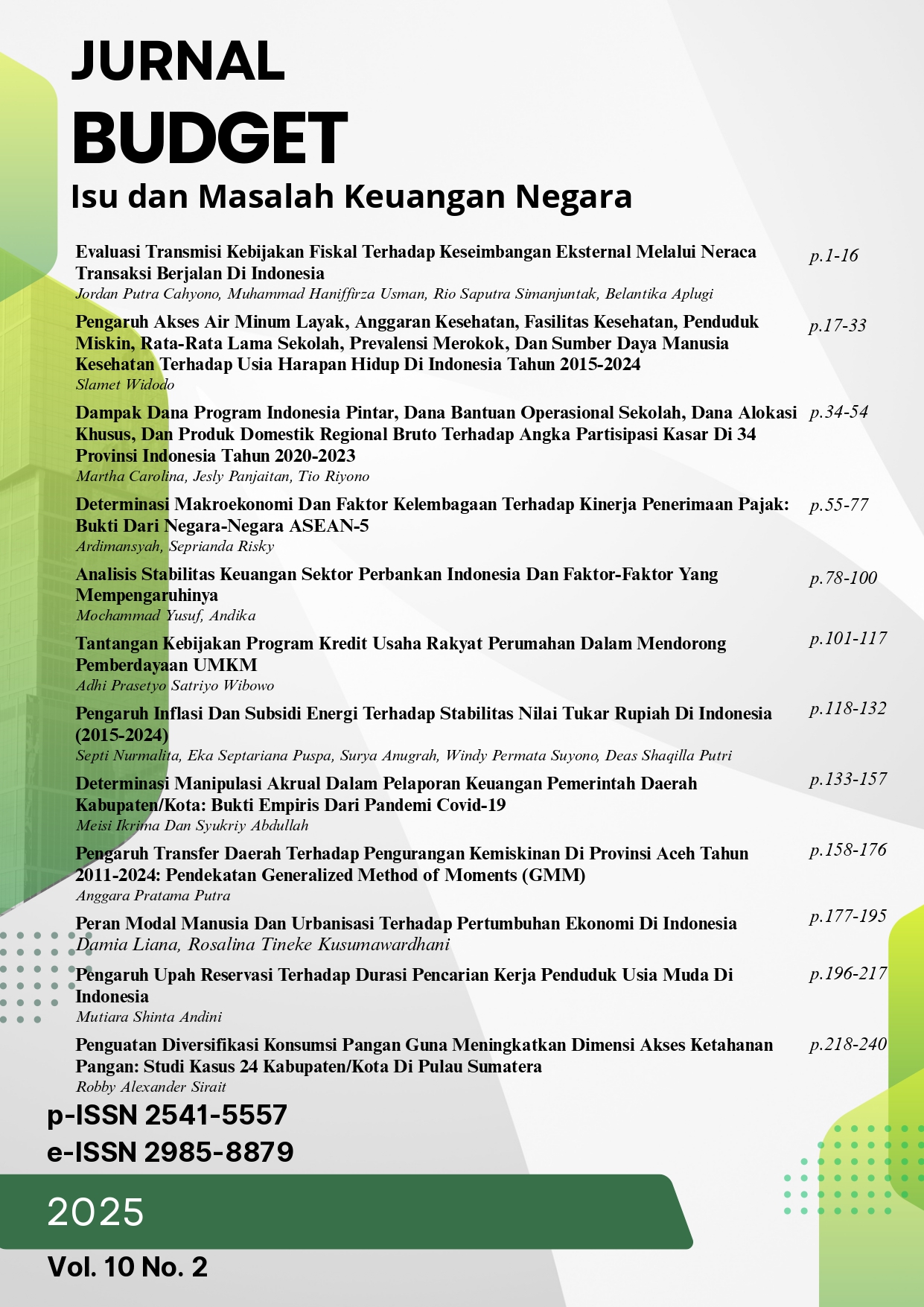
The Role of Human Capital and Urbanization in Driving Economic Growth in Indonesia
Keywords:
ARDL, economic growth, human capital, labor force, urbanizationAbstract
This study examines the impact of urbanization, education, interaction between urbanization and education, government expenditure, labor, and trade on Indonesia’s economic growth. Using the Autoregressive Distributed Lag (ARDL) approach, the analysis distinguishes the short-run and long-run effects of each variable on GDP. The results show that urbanization positively affects long-run growth through agglomeration economies, while education significantly enhances productivity in line with endogenous growth theory. However, urbanization without adequate skill improvement reduces productivity due to labor skill mismatches in urban areas. Government expenditure has a negative short-run effect but a positive long-run impact, indicating fiscal adjustment lags before investment spending stimulates growth. Meanwhile, trade shows a negative long-run relationship, reflecting dependence on imported consumer goods and low-value commodity exports. The findings highlight the importance of strengthening human capital, improving fiscal efficiency, and promoting trade policies that enhance domestic value-added to achieve inclusive and sustainable economic growth.
References
Amala, I. A., Arrahmah, N., & Amalina, E. N. (2022). Educational Progress as a Booster of Economic Growth in Indonesia. Equity: Jurnal Ekonomi, 10(2), 1–11. https://doi.org/10.33019/equity.v10i2.116
Ashraf, Q. H., & Weil, D. N. (2024). Economic Growth (4th ed.). Routledge. https://doi.org/10.4324/9781315147635
Azzahra, A., Rahayu, R., Marlina, N. S., Saebah, N., & Saputro, W. E. (2024). The Role of Education in Economic Growth and Breaking the Chain of Poverty in Indonesia. Journal of Management, Economic, and Financial, 2(2), 55–63. https://doi.org/10.46799/jmef.v2i2.31
Badan Pusat Statistik. (2024). Dinamika Konsumsi Lahan Wilayah Urban di Indonesia.
BPS. (2024). Indikator Pasar Tenaga Kerja.
Burgi, C., Hovhannisyan, S., & Mondragon-Velez, C. (2024). GDP-Employment Elasticities across Developing Economies (Policy Research Working Paper). https://hdl.handle.net/10986/42488
Cao, S., Yu, N., Wu, Y., Wang, Z., & Mi, J. (2020). The Educational Level of Rural Labor, Population Urbanization, and Sustainable Economic Growth in China. Sustainability, 12(12), 4860. https://doi.org/10.3390/su12124860
Carvelli, G. (2023). The long-run effects of government expenditure on private investments: a panel CS-ARDL approach. Journal of Economics and Finance, 47(3), 620–645. https://doi.org/10.1007/s12197-023-09617-y
Chang, Y. S., Kim, M. J., Kim, S. M., & Jo, S. J. (2023). The Offsetting Impact of Dependency and Urbanization on Mean Years of Schooling: A Scaling Analysis of 97 Countries. Sage Open, 13(2). https://doi.org/10.1177/21582440231165748
Chen, M., Zhang, H., Liu, W., & Zhang, W. (2014). The Global Pattern of Urbanization and Economic Growth: Evidence from the Last Three Decades. PLoS ONE, 9(8), e103799. https://doi.org/10.1371/journal.pone.0103799
Domínguez Blancas, C. S., & Ángeles Castro, G. (2024). Trade Liberalization Effects on Economic Growth, 1980-2022. Revista Mexicana de Economía y Finanzas, 19(3), 1–22. https://doi.org/10.21919/remef.v19i3.992
Elfaki, K. E., Handoyo, R. D., & Ibrahim, K. H. (2021). The Impact of Industrialization, Trade Openness, Financial Development, and Energy Consumption on Economic Growth in Indonesia. Economies, 9(4), 174. https://doi.org/10.3390/economies9040174
Hapsari, I. M., Yu, S., Pape, U. J., & Mansour, W. (2023). Informality in Indonesia: Levels, Trends, and Features (10586; Policy Research Working Papers).
Haryanto, T., Erlando, A., & Utomo, Y. (2021). The Relationship between Urbanization, Education, and GDP per capita in Indonesia. The Journal of Asian Finance, Economics and Business(JAFEB), 8(5), 561–572. https://doi.org/doi.org/10.13106/jafeb.2021.vol8.no5.0561
Hassan, M. E. E., & Pitoyo, A. J. (2018). Urbanization and Economic Development in Indonesia: Demographic Perspectives Analysis. Populasi, 25(2), 54. https://doi.org/10.22146/jp.36205
Jing, H. (2015). The Principle of Urbanization Promoting Chinese Economic Growth. https://doi.org/10.2991/iccset-14.2015.95
Kemendikbud. (2023). Perkembangan APK/APM .
Khoiruddin, M. A., Setyanti, A. M., Suman, A., Prasetyia, F., & Susilo, S. (2024). Exploring Determinants of Education-Job Mismatch Among Educated Workers in Indonesia. Jurnal Ekonomi Pembangunan: Kajian Masalah Ekonomi Dan Pembangunan, 263–281. https://doi.org/10.23917/jep.v25i2.23994
Krugman, P. (1991). Increasing Returns and Economic Geography. Journal of Political Economy, 99(3), 483–499. https://doi.org/10.1086/261763
Li, X., Song, W., Cao, S., Mo, Y., Du, M., & He, Z. (2024). The impact of multidimensional urbanization on sustainable development goals (SDGs): A long-term analysis of the 31 provinces in China. Ecological Indicators, 169, 112822. https://doi.org/10.1016/j.ecolind.2024.112822
Liu, Y., Yang, M., & Cui, J. (2024). Urbanization, economic agglomeration and economic growth. Heliyon, 10(1), e23772. https://doi.org/10.1016/j.heliyon.2023.e23772
Lucas, R. E. (1988). On the mechanics of economic development. Journal of Monetary Economics, 22(1), 3–42. https://doi.org/10.1016/0304-3932(88)90168-7
Mankiw, N. G., Romer, D., & Weil, D. N. (1992). A Contribution to the Empirics of Economic Growth. The Quarterly Journal of Economics, 107(2), 407–437. https://doi.org/10.2307/2118477
Mendez, P., Atienza, M., & Modrego, F. (2023). Urbanization and productivity at a global level: new empirical evidence for the services sector. Regional Science Policy & Practice, 15(9), 1981–1998. https://doi.org/10.1111/rsp3.12620
Nguyen, H. M., & Nguyen, L. D. (2018). The relationship between urbanization and economic growth. International Journal of Social Economics, 45(2), 316–339. https://doi.org/10.1108/IJSE-12-2016-0358
OECD. (2015). The causes and consequences of field-of-study mismatch (OECD Social, Employment and Migration Working Papers, Vol. 167). https://doi.org/10.1787/5jrxm4dhv9r2-en
OECD. (2017). Skills mismatch, productivity and policies. https://doi.org/10.1787/65dab7c6-en
OECD. (2020). Employment and Skills Strategies in Indonesia. OECD Publishing. https://doi.org/10.1787/dc9f0c7c-en
Purwono, R., Sugiharti, L., Handoyo, R. D., & Esquivias, M. A. (2022). Trade Liberalization and Comparative Advantage: Evidence from Indonesia and Asian Trade Partners. Economies, 10(4), 80. https://doi.org/10.3390/economies10040080
Romer, P. M. (1990). Endogenous Technological Change. Journal of Political Economy, 98(5), 71–102.
Sairmaly, F. A. (2023). Human Capital Development and Economic Growth: A Literature Review on Information Technology Investment, Education, Skills, and Productive Labour. Jurnal Minfo Polgan, 12(1), 679–693. https://doi.org/10.33395/jmp.v12i1.12491
Sari, V. K. (2023). The Role of Education towards Economic Growth: Evidence from Indonesia. JURNAL DINAMIKA EKONOMI PEMBANGUNAN, 5(3), 221–228. https://doi.org/10.14710/jdep.5.3.221-228
Setiyanto, A. (2021). Indonesia’s Capital Expenditure and Economic Growth 1990-2020: Role of Accountability. Jurnal Tata Kelola Dan Akuntabilitas Keuangan Negara, 245–256. https://doi.org/10.28986/jtaken.v7i2.653
Solow, Robert. M. (1956). A Contribution to the Theory of Economic Growth. The Quarterly Journal of Economics, 70(1), 65–94.
Todaro, M. P., & Smith, S. C. (2020). Economic Development (13th ed.). Addison-Wesley, Pearson.
Urama, C. E., Ukwueze, E. R., Obodoechi, D. N., Ogbonna, O. E., Eze, A. A., Alade, O. B., & Ugwu, P. N. (2022). Women’s Labour Force Participation: Economic Growth Nexus in Sub-Saharan African Countries. Journal of International Women’s Studies, 24(5). https://vc.bridgew.edu/jiws/vol24/iss5/9?utm_source=vc.bridgew.edu%2Fjiws%2Fvol24%2Fiss5%2F9&utm_medium=PDF&utm_campaign=PDFCoverPages
Yudhistira, M. H., Brodjonegoro, B. P. S., & Qibthiyyah, R. M. (2024). Unlocking Urban Potential. Bulletin of Indonesian Economic Studies, 60(2), 129–159. https://doi.org/10.1080/00074918.2024.2389492
Published
How to Cite
Issue
Section
License
Copyright (c) 2026 Damia Liana, Rosalina Tineke Kusumawardhani

This work is licensed under a Creative Commons Attribution-NonCommercial-ShareAlike 4.0 International License.
Jurnal Budget is licensed under a Creative Commons Attribution-NonCommercial-ShareAlike 4.0 International License. Permissions beyond the scope of this license may be available at https://ejurnal.dpr.go.id/index.php/jurnalbudget/index.