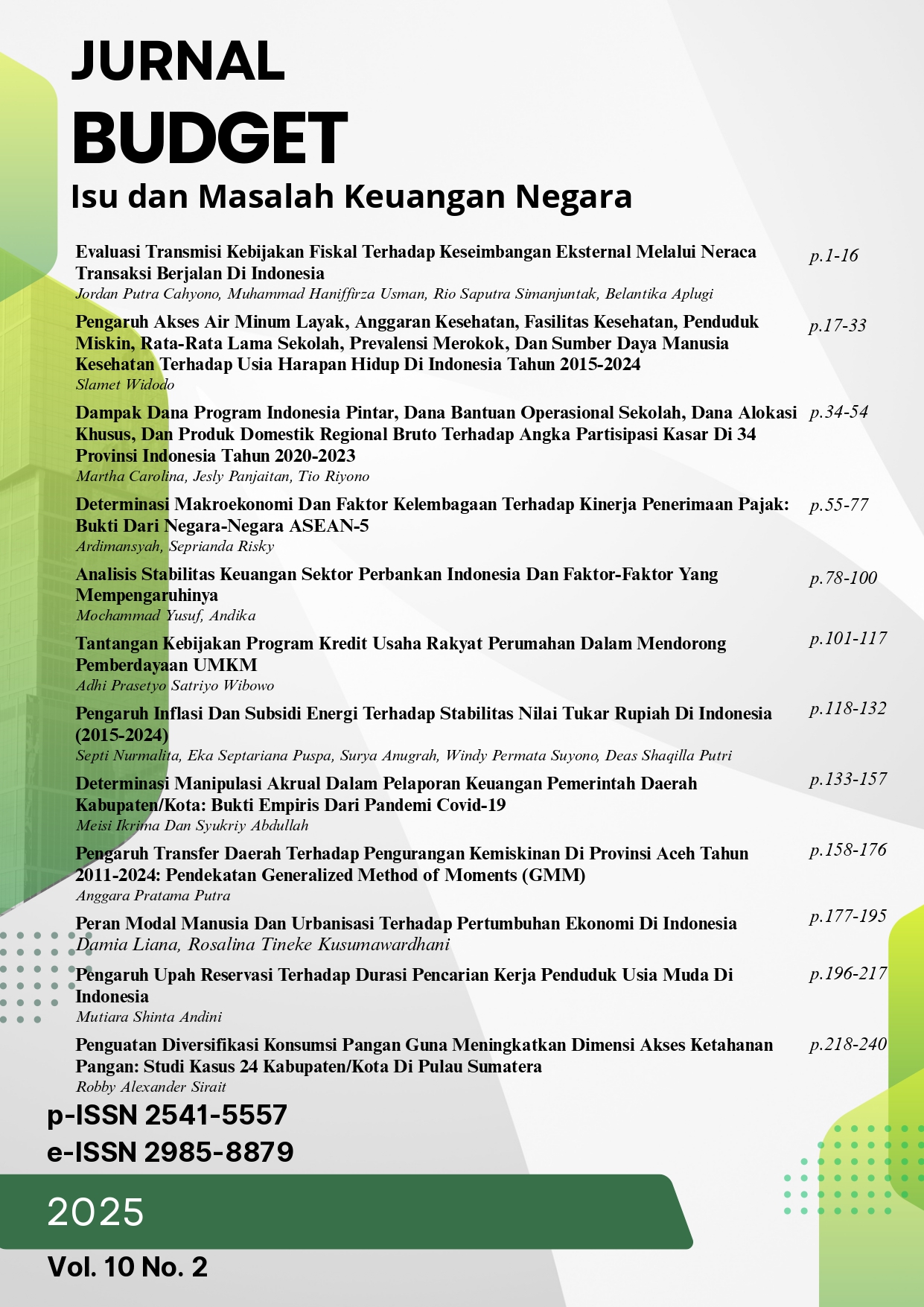
The Effect of Reservation Wages on The Duration of Job Search among Young Workforce in Indonesia
Keywords:
reservation wage, duration of job search, young workforce, OLSAbstract
This study analyzes the effect of reservation wages on the duration of job search for young people in Indonesia using SAKERNAS data. Reservation wages are defined as the minimum wage level that individuals are willing to accept to enter the job market, while the duration of the job search is measured from the length of time it takes to find a job until obtaining the first job. The method used is Ordinary Least Squares (OLS) with robust standard errors to overcome heteroscedasticity. The results showed that the higher the reservation wage, the longer the duration of the job search, indicating that excessively high wage preferences can prolong unemployment. Control variables such as type of education, work experience, gender, and location of residence also had a significant effect on the duration of the job search. These findings provide a new understanding of the dynamics of the transition of the young workforce in Indonesia and the importance of policies that encourage labor market information and skill improvement to reduce wage expectation mismatch.
References
Adinkra-Darko, E., & Ahiakpor, F. (2024). Unemployment duration and its covariates: Evidence from selected regions in Ghana. Sage Open, 14(4), 21582440241287606.
Albrecht, J., van Vuuren, A., & Vroman, S. (2015). The black–white wage gap among young women in 1990 vs. 2011: The role of selection and educational attainment. Labour Economics, 33, 66-71.
Anwar, M., Rahman, R., dan Suryanto, D. (2021). Youth Employment and Wage Expectation in Indonesia. Indonesian Journal of Economic Studies, 13(2), 101–118.
Badan Pusat Statistik (BPS). (2023). Pedoman Konseptual dan Definisi SAKERNAS 2023. Jakarta: BPS.
Badan Pusat Statistik. (2024). Hasil Survei Angkatan Kerja Nasional (SAKERNAS) Agustus 2023. Jakarta: BPS.
Baillie, R. T., & Kim, K. H. (2018). Choices between OLS with robust inference and feasible GLS in time series regressions. Economics letters, 171, 218-221.
Borjas, G. J. (2016). Labor Economics (7th ed.). New York: McGraw-Hill Education.
Byrne, B. M. (2016). Structural Equation Modeling with AMOS: Basic Concepts, Applications, and Programming (3rd ed.). Routledge.
Clark, A. E., Cotofan, M., & Layard, R. (2024). Do wages underestimate the inequality in workers' rewards? The joint distribution of job quality and wages across occupations. Economica, 91(362), 497-546.
Daoud, J. (2017). Multicollinearity and regression analysis. Sociological Methods & Research, 46(4), 645–671.
Davis, S. J., & Krolikowski, P. M. (2024). Reservation wages revisited: Empirics with the canonical model (No. 24-23). Federal Reserve Bank of Cleveland.
Deschacht, N. (2021). The effect of unemployment duration on reservation wages: Evidence from Belgium. Labour Economics, 71.
Dewi, R. S., dan Handayani, D. D. (2022). Pengaruh upah reservasi dan umur terhadap lama mencari kerja di Indonesia Jurnal Kependudukan Indonesia, 17(1), 2022.
Eckstein, Z., dan Van den Berg, G. J. (2007). Empirical Labor Search: A Survey. Journal of Econometrics, 136(2), 531–564.
Ehrenberg, R. G., dan Smith, R. S. (2017). Modern labor economics: Theory and public policy. Routledge.
Faberman, R. J., Mueller, A. I., dan Şahin, A. (2022). Has the Willingness to Work Fallen during the Covid Pandemic? Labour Economics, 79.
Fedorets, A., Grözinger, G., dan Tamm, M. (2018). Reservation Wages and the Wage Offers of Unemployed Workers: Evidence from a Large-Scale Field Experiment. Labour Economics, 55, 164–176.
Hayes, A., & Setyonaluri, D. (2015). Taking advantage of the demographic dividend in Indonesia. A Brief Introduction to Theory and Practice.
Hofler, R. A., & Murphy, K. J. (1994). Estimating reservation wages of employed workers using a stochastic frontier. Southern Economic Journal, 961-976.
International Labour Organization. (2022). Global Employment Trends for Youth 2022: Investing in transforming futures for young people. Geneva: ILO.
International Labour Organization (ILO). (2023). ILOSTAT Methodology: Youth Employment Indicators. Geneva: ILO.
Ioannides, Y. M., dan Datcher Loury, L. (2004). Job Information Networks, Neighborhood Effects, and Inequality. Journal of Economic Literature, 42(4), 1056–1093.
Jana, P., Rosadi, D., dan Supandi, E. D. (2023). Comparison of robust estimation on multiple regression model. BAREKENG: J. Math. dan App, 17(2), 0979-0988.
Kesternich, I., Schumacher, H., Siflinger, B., dan Schwarz, S. (2021). Money or meaning? Labor supply responses to work meaning of employed and unemployed individuals. European Economic Review, 137.
Khan, B. M., & Majid, M. F. (2020). A note on the gender reservation wage gap in developing countries. Scottish Journal of Political Economy, 67(5), 462-468.
Khan, T., & Majid, A. (2019). Determinants of Reservation Wage and its Impact on Job Search Duration: Evidence from Urban Pakistan. Pakistan Development Review, 58(3), 231–250.
Kementerian Ketenagakerjaan Republik Indonesia. (2024). Data Upah Minimum Provinsi (UMP) Tahun 2024. Jakarta: Kemenaker RI.
Kementerian Keuangan Republik Indonesia. (2024). APBN Kita: Laporan Realisasi Semester I Tahun 2024. Jakarta: Direktorat Jenderal Anggaran.
Kementerian Koordinator Bidang Perekonomian Republik Indonesia. (2023). Evaluasi Program Kartu Prakerja Tahun 2020–2023. Jakarta: Kemenko Perekonomian.
Kunz, J., & Uhlig, H. (2015). The effect of reservation wages on job search duration: Evidence from the Swiss labor market. Labour Economics, 33, 27-40.
Le Barbanchon, T., Schmieder, J., & Weber, A. (2024). Job search, unemployment insurance, and active labor market policies. In Handbook of Labor Economics (Vol. 5, pp. 435-580). Elsevier.
Leppin, J. S. (2014). The estimation of reservation wages: A simulation-based comparison. Jahrbücher für Nationalökonomie und Statistik, 234(5), 603-634.
Liu, K. (2019). Wage risk and the value of job mobility in early employment careers. Journal of Labor Economics, 37(1), 139-185.
Mason, A., Lee, R., & Jiang, J. X. (2016). Demographic dividends, human capital, and saving. The Journal of the Economics of Ageing, 7, 106.
OECD. (2024). OECD Employment Outlook 2024. OECD Publishing.
Pannenberg, M. (2020). Risk attitudes and reservation wages of unemployed workers: New evidence from panel data. Economics Letters, 191, 109092.
Pasay, N. H., dan Indrayanti, R. (2012). Pengangguran, Lama Mencari Kerja, dan Reservation Wage Tenaga Kerja Terdidik. Jurnal Ekonomi Dan Pembangunan Indonesia, 12(2), 3.
Van Ophem, H., Hartog, J., dan Berkhout, P. (2011). Reservation wages and starting wages (No. 5435). IZA Discussion Papers.
Zuo, G., & Lai, W. (2020). Reservation wages, unemployment duration, and labour-market outcomes: Evidence from Chinese college graduates. China Economic Review, 63, 101512.
Zuo, B., & Lai, Z. (2020). The effect of housing wealth on tourism consumption in China: Age and generation cohort comparisons. Tourism Economics, 26(2), 211-232.
Published
How to Cite
Issue
Section
License
Copyright (c) 2026 Mutiara Shinta Andini

This work is licensed under a Creative Commons Attribution-NonCommercial-ShareAlike 4.0 International License.
Jurnal Budget is licensed under a Creative Commons Attribution-NonCommercial-ShareAlike 4.0 International License. Permissions beyond the scope of this license may be available at https://ejurnal.dpr.go.id/index.php/jurnalbudget/index.