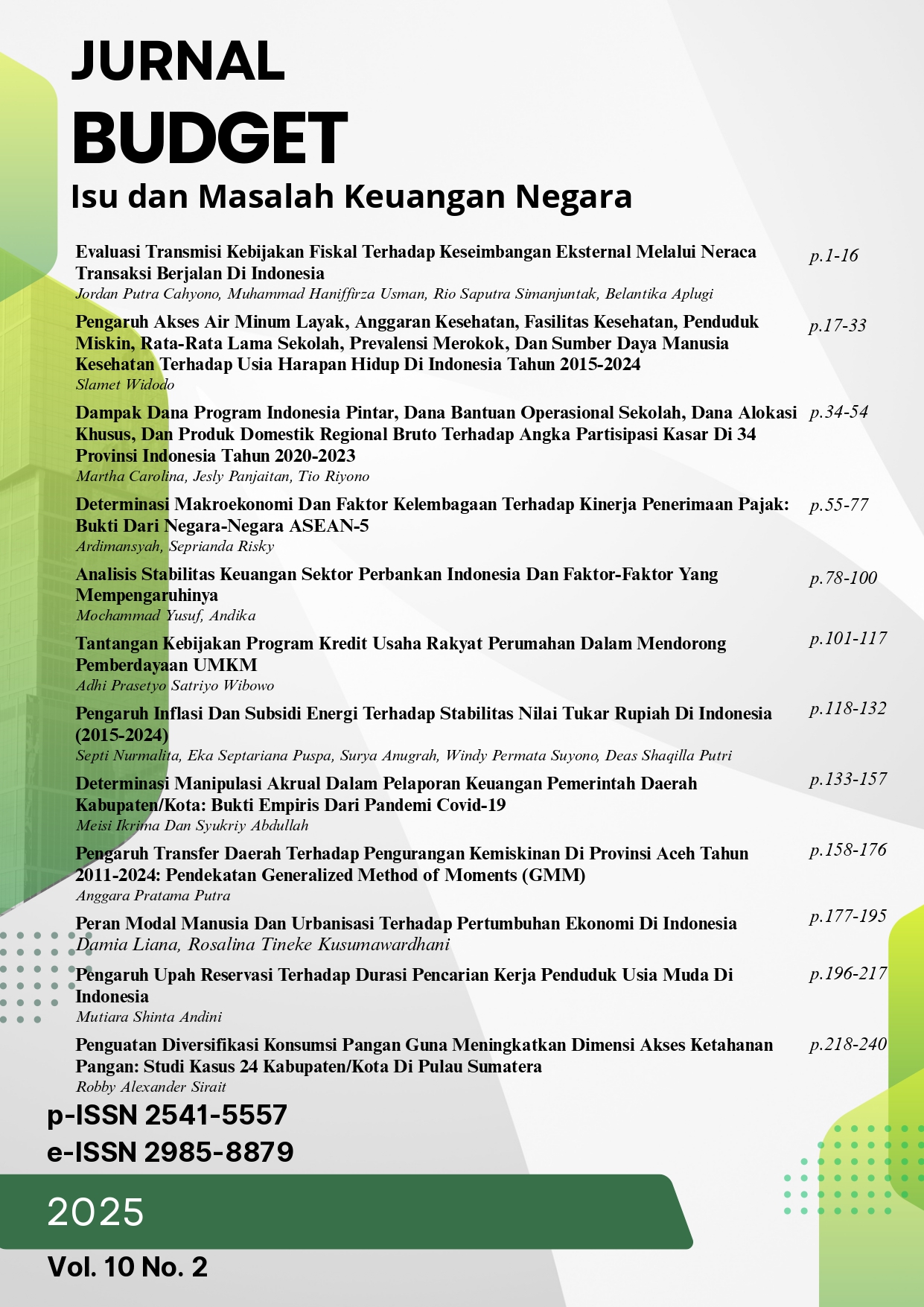
The Effect of Regional Transfers on Poverty Reduction in Aceh Province From 2011 to 2024: A Generalized Method of Moments (GMM) Approach
Keywords:
Poverty, Social Assistance, Human Development Index, Open Unemployment Rate, Generalized Method of MomentsAbstract
This study analyzes the impact of government spending—including social assistance, financial assistance, grants, and subsidies—on poverty reduction in Aceh Province using the Generalized Method of Moments (GMM) approach. Although the government budget continues to increase, poverty reduction in Aceh remains suboptimal, mainly due to structural and socio-economic challenges exacerbated by the COVID-19 pandemic. One aspect that has been rarely studied is the impact of financial assistance spending, especially in Aceh, which has unique socio-economic characteristics. This study integrates key socio-economic indicators, such as the Human Development Index (HDI) and the Open Unemployment Rate, to analyze their combined impact on poverty levels. The findings show that social assistance and financial assistance have a significant impact but tend to increase poverty. This is due to the dependency that arises from uneven distribution and the lack of sustainable economic empowerment. On the other hand, grants were found to contribute positively to poverty reduction, while subsidies did not show a significant impact. In addition, higher HDI scores were associated with lower poverty rates, while higher unemployment rates were associated with higher poverty rates. These findings highlight the importance of targeted fiscal policies and efficient resource allocation to address the root causes of poverty. This study provides valuable insights for improving policy formulation and implementation of poverty alleviation programs in Aceh, emphasizing the need for a holistic approach that combines human capital development and the creation of sustainable economic opportunities.
References
Ayala, L., Cantó, O., & Rodríguez, J. G. (2017). Poverty and the business cycle: A regional panel data analysis for Spain using alternative measures of unemployment. Journal of Economic Inequality, 15(1), 47–73. https://doi.org/10.1007/s10888-016-9343-5
Azis Muthalib, A., Adam, P., Saenong, Z., & Ode Suriadi, L. (2018). The influence of fuel prices and unemployment rate towards the poverty level in Indonesia International Journal of Energy Economics and Policy The Influence of Fuel Prices and Unemployment Rate towards the Poverty Level in Indonesia. International Journal of Energy Economics and Policy |, 8(3), 37–42. http://hdl.handle.net/11159/2097https://www.zbw.eu/https://savearchive.zbw.eu/termsofusehttp:www.econjournals.com
Belhadj, B., & Kaabi, F. (2021). The Relationship Between Employment and Poverty Using Fuzzy Regression. In Analysis of Socio-Economic Conditions (pp. 264–275). Routledge. https://doi.org/10.4324/9781003053712-17
BPS. (2024). Tingkat pengangguran terbuka Indonesia 2024. Badan Pusat Statistik.
Ciptawaty, U., Ambya, A., Nairobi, N., Suparta, I. W., Djayasinga, M., & Wahyudi, H. (2025). The poverty alleviation program in A Tsunami impacted area: Models PKH and BPNT Indonesia. Edelweiss Applied Science and Technology, 9(3), 2184–2198. https://doi.org/10.55214/25768484.v9i3.5758
Elshahawany, D. N., & Elazhary, R. H. (2022). Government Spending and Regional Poverty Alleviation: Evidence from Egypt. www.erf.org.eg
Fadhli, M., Away, Y., Agussabti, A., & Nasaruddin, N. (2025). Classification of Recipients of Uninhabitable Housing Assistance in Aceh Province Based on Supervised Learning. 2025 4th International Conference on Electronics Representation and Algorithm (ICERA), 1–6. https://doi.org/10.1109/ICERA66156.2025.11087296
Ganiyou, I. *, & Yovo, K. (2022). Effect of targeted fertiliser subsidy on poverty reduction in Togo. African Journal of Agricultural and Resource Economics, 17(3), 192–205. https://doi.org/10.53936/afjare.2022.17(2).13
Purba, G. F. B., Sinulingga, D. M. C., Togatorop, J., & Harahap, L. M. (2025). Peran Program Bantuan Sosial dalam Pengentasan Kemiskinan : Evaluasi Dari Berbagai Penelitian. Jurnal Publikasi Ilmu Manajemen, 4(1), 108–117. https://doi.org/10.55606/jupiman.v4i1.4956
Hasiholan, D., Hamzah, M. Z., Sofilda, E., Hariyanti, D., & Authour, ©. (2022). Relationship Analysis Between Unemployment and Poverty in 33 Provinces In Indonesia. www.oidaijsd.comAlsoavailableathttp://www.ssrn.com/link/OIDA-Intl-Journal-Sustainable-Dev.html
Hosan, S., Sen, K. K., Rahman, Md. M., Karmaker, S. C., Chapman, A. J., & Saha, B. B. (2023). Evaluating the mediating role of energy subsidies on social well-being and energy poverty alleviation in Bangladesh. Energy Research & Social Science, 100, 103088. https://doi.org/10.1016/j.erss.2023.103088
Huo, X., & Gao, Q. (2025). Inequality in social assistance provision and receipt. In Handbook on Inequality in China (pp. 409–429). Edward Elgar Publishing. https://doi.org/10.4337/9781035317806.00021
Jalil, H., Yani, T. A., & Kurniawan, A. (2019). Optimization of Special Autonomy Funds Allocation to Alleviate Poverty in Aceh (A Case Study in Districts/Cities). www.ijicc.net
Khadafi, R., & Mutiarin, D. (2017). Efektivitas Program Bantuan Keuangan Khusus Dalam Mengentaskan Kemiskinan di Kabupaten Gunungkidul. Journal of Governance and Public Policy, 4(2). https://doi.org/10.18196/jgpp.4280
Kiendrebeogo, Y., Assimaidou, K., & Tall, A. (2017). Social protection for poverty reduction in times of crisis. Journal of Policy Modeling, 39(6), 1163–1183. https://doi.org/10.1016/j.jpolmod.2017.09.003
Langi, C. R., Zulfikar, A. L., Maulana, I., Widayati, N., & Yudaruddin, R. (2023). The impact of social aid on poverty during the COVID-19 pandemic: Empirical evidence from Indonesia. Public and Municipal Finance, 12(2), 104–116. https://doi.org/10.21511/pmf.12(2).2023.09
Marshall, T. H. (1950). Citizenship and social class. Cambridge University Press.
Masrizal, M., Zulham, T., Aliasuddin, A., Taufiq, , & Dawood, C. (2024). Does Fiscal Inefficiency and Human Capital Affect Poverty in Aceh Province, Indonesia? A Threshold Approach. Review of Applied Socio-Economic Research, 70–82.
Ngubane, M. Z., Mndebele, S., & Kaseeram, I. (2023). Economic growth, unemployment and poverty: Linear and non-linear evidence from South Africa. Heliyon, 9(10). https://doi.org/10.1016/j.heliyon.2023.e20267
Olivia, M., Nurviana, N., & Fairus, F. (2023). Cluster analysis for district/city grouping based on variables affecting poverty in Aceh province using average linkage method.METHOD. BAREKENG: Jurnal Ilmu Matematika Dan Terapan, 17(4), 1865–1872. https://doi.org/10.30598/barekengvol17iss4pp1865-1872
Panjawa, J. L., Sugiharti, R., Kurniawan, M. A., & Jalunggono, G. (2023). Is there any relation between human development and poverty in Eastern Indonesia? 020025. https://doi.org/10.1063/5.0154798
Putri, W. M., Santosa, P. B., Zusak, M. B. F., & Mi’raj, D. A. (2025). The Nexus between The Islamic Human Development Index (I-HDI), Unemployment, and Population Growth in Influencing Poverty. Economica: Jurnal Ekonomi Islam, 16(1), 45–61. https://doi.org/10.21580/economica.2025.16.1.25152
Rawls, J. (1971). A theory of justice. Harvard University Press.
Ricardo, D. (1817). On the principles of political economy and taxation. John Murray.
Sadath, A. C., & Acharya, R. H. (2021). Access to modern energy services and human development in India: Has government policies paid off? International Journal of Energy Economics and Policy, 11(3), 432–442. https://doi.org/10.32479/ijeep.10949
Sari, D. I. , & M. F. (2023). Pengaruh Belanja Subsidi, Belanja Hibah dan Belanja Bantuan Sosial terhadap Kemiskinan di Indonesia. Indo-Fintech Intellectuals: Journal of Economics and Business, 3(2), 346–359.
Sawadogo, B., & Maisonnave, H. (2021). Politiques de subventions aux engrais au Burkina Faso : une comparaison des impacts par mode de financement à l’aide d’un modèle d’équilibre général calculable. Mondes En Développement, n° 195(3), 11–28. https://doi.org/10.3917/med.195.0011
Sen, A. (1999). Development as freedom. Alfred A. Knopf.
Shitile, T. S., & Sule, A. (2019). Reassessing the Efficacy of Foreign Aid and Grants in Poverty Reduction in Nigeria. Asian Economic and Financial Review, 9(4), 450–460. https://doi.org/10.18488/journal.aefr.2019.94.450.460
Sihombing, P. R., & Arsani, A. M. (2021). Static and dynamic panel models: Which is better? (Case study: Poverty data in Indonesia 2012-2019). IOP Conference Series: Earth and Environmental Science, 739(1). https://doi.org/10.1088/1755-1315/739/1/012057
Singh, J., & Singh, M. (2023). Does financial inclusion impact socio-economic stability? A study of social safety net in Indian slums. International Journal of Social Economics, 50(8), 1060–1084. https://doi.org/10.1108/IJSE-04-2022-0261
Smith, A. (1776). The wealth of nations. Teori Strukturalis oleh Karl Marx:
Sofro, A. yunin, Aidha, S. D. N., & Khikmah, K. N. (2023). Forecasting poverty in East Java using vector autoregressive method and vector error correction model. E3S Web of Conferences, 450. https://doi.org/10.1051/e3sconf/202345003004
Suriani, S., Riyaldi, M. H., Nurdin, R., Fadliansah, O., & Wintara, H. (2021). Zakat and Sustainable Development: Effect of Zakat and Macroeconomic Variables on Dependency Ratio and Poverty. 2021 International Conference on Decision Aid Sciences and Application, DASA 2021, 392–396. https://doi.org/10.1109/DASA53625.2021.9682377
Suwardi, W. Z., & Islamiah, N. (2024). Analisis Pengeluaran Pemerintah di Sektor Subsidi dan Pendidikan : Tidak Ada Hubungan Langsung dengan Kemiskinan. Jurnal Online Manajemen ELPEI, 4(2).
Tantriana, A. (2024). Poverty and vulnerability transitions in Indonesia before and during the COVID-19: insights from synthetic panels. Quality and Quantity, 58(4), 3215–3249. https://doi.org/10.1007/s11135-023-01785-7
United Nations Development Programme (UNDP). (1990). Human development report 1990: Concept and measurement of human development. Oxford University Press.
Vandeninden, F., Grun, R., & Fecher, F. (2022). Energy subsidies and poverty: The case of fossil fuel subsidies in Burkina Faso. Energy for Sustainable Development, 70, 581–591. https://doi.org/10.1016/j.esd.2022.08.023
Wagle, U. R. (2017). How much do social protections matter to poverty and inequality? An insight from Asian experiences. Global Social Policy, 17(2), 137–167. https://doi.org/10.1177/1468018116675496
Wijatmoko, E., Armawi, A., & Fathani, T. F. (2023). Uncovering the Challenges of Sustainable Development in North Aceh: A Policy Analysis of Special Transfer Funds. Sustainability (Switzerland), 15(11). https://doi.org/10.3390/su15118585
World Bank. (2000). Attacking poverty: World development report 2000/2001. Oxford University Press.
Yuliandri, Kabullah, M. I., Fahmi, K., Amsari, F., & Fajri, M. N. (2021). Beyond the tsunami effect: Towards an understanding of the special autonomy budget policy in reducing poverty in Aceh. IOP Conference Series: Earth and Environmental Science, 708(1). https://doi.org/10.1088/1755-1315/708/1/012084
Zreik, M., & Haron, N. F. (2025). The Impact of Social Financial Grants on Poverty Alleviation in Rural Indonesia: A Demographic and Econometric Analysis. Asian Social Work and Policy Review, 19(2). https://doi.org/10.1111/aswp.70011
Zreik, M., & Iqbal, B. A. (2025). Social financial grants [SFGs] and poverty eradication in South Africa. Development Southern Africa, 42(1), 107–118. https://doi.org/10.1080/0376835X.2024.2434222
Published
How to Cite
Issue
Section
License
Copyright (c) 2026 Anggara Pratama Putra

This work is licensed under a Creative Commons Attribution-NonCommercial-ShareAlike 4.0 International License.
Jurnal Budget is licensed under a Creative Commons Attribution-NonCommercial-ShareAlike 4.0 International License. Permissions beyond the scope of this license may be available at https://ejurnal.dpr.go.id/index.php/jurnalbudget/index.