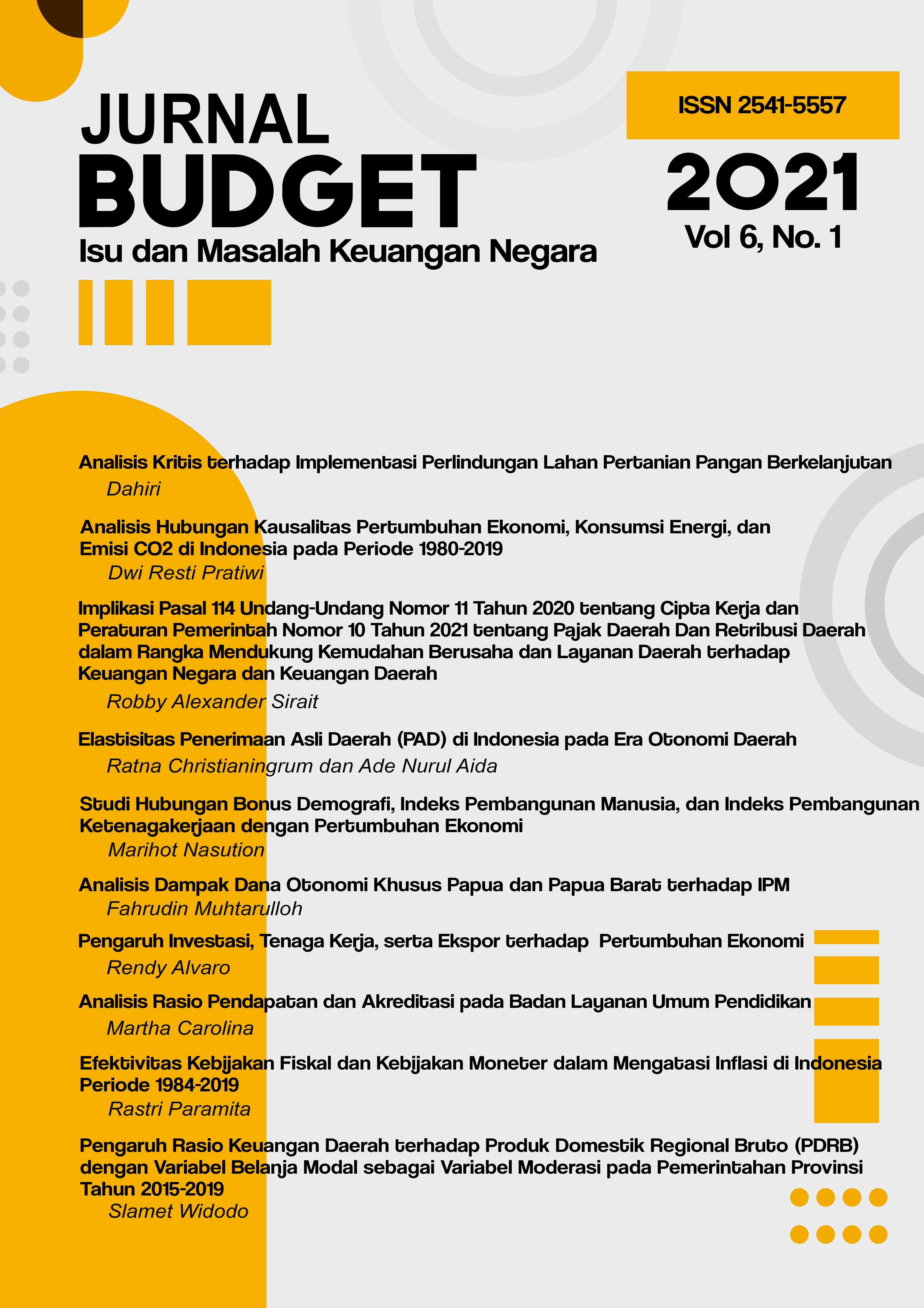
Relationship between Demographic Bonus, Human Development Index, and Employment Development Index with Economic Growth
DOI:
https://doi.org/10.22212/jbudget.v6i1.74Keywords:
demographic bonus, human development index, employment development index, economic growthAbstract
The purpose of this study was to analyze the causality between demographic bonuses, the Human Development Index (HDI), and the Employment Development Index (IPK) on regional economic growth in the territory of Indonesia. The demographic bonus has a positive effect on economic growth because the productive age population earns income, so that overall it contributes to the gross regional domestic product. HDI is a condition in which every resident is able to access development results in obtaining income, health, and education, so that it can trigger economic growth. The IPK figure is a value that describes the conditions for the success of manpower development in a composite which includes 9 (nine) very basic main indicators of manpower development and if these indicators are managed properly, it will trigger economic growth. This study uses secondary data or time series data collected from BPS and the Ministry of Manpower.
References
Adioetomo, Sri Moertiningsih. (2005). Bonus Demografi. Menjelaskan Hubungan antara Pertumbuhan Penduduk dengan Pertumbuhan Ekonomi. Pidato pengukuhan Guru Besar Tetap Bidang Ekonomi pada Fakultas Ekonomi Universitas Indonesia. Jakarta.
________________________. (2007). Demographic dividend and its implication for human capital development in Indonesia. Paper presented at a seminar on Demographic Dividend and Intergenerational Transfer, Demographic Institute FEUI and East West Center, Jakarta, 13 August 2007.
________________________. (2018). Memetik Bonus Demografi: Membangun Manusia Sejak Dini. Depok: PT. RajaGrafindo Persada. ISBN 978-602-425-241-0.
Aksoy, Y., Basso, H. S., & Smith, R. P. (2017). Medium-run implications of changing demographic structures for the macro-economy. National Institute Economic Review, 241(1), R58-R64. doi: https://doi.org/10.1177%2F002795011724100114.
Badan Pusat Statistik. (2017). Indeks Pembangunan Manusia 2016. Jakarta: CV. Rioma.
_________________. (2020). Indeks Pembangunan Manusia 2020. Berita Resmi Statistik No. 97/12/Th. XXIII, 15 Desember 2020. bps.go.id.
_________________. 2020. bps.go.id
_________________. (2021). Keadaan Ketenagakerjaan Indonesia Februari
Berita Resmi Statistik No.37/05/Th. XXIV, 05 Mei 2021. bps.go.id
Basuki, Agus Tri. 2020. Tutorial Uji Kausalitas Granger. Bahan Ajar. Diakses dari https://ekonometrikblog.files.wordpress.com/2020/07/tutorial-uji-kausalitasgranger-ok.pdf
Batini, N., Callen, T., and McKibbin, W. J. 2006. The global impact of demographic change. IMF working Paper No. 06/9.
Birdsall, Nancy, Kelley, A.C dan Sinding, Steven W. (2001). Population Matters: Demographic Change, Economic Growth, and Poverty in the Developing World. Oxford University Press, 2003. https://www.cgdev.org/doc/expert%20pages/birdsall/Population%20_Matter
s.pdf
Bloom, David E., Canning, David, dan Fink, Günther. (2008). Population Aging and Economic Growth. PGDA Working Paper No. 31. https://cdn1.sph.harvard.edu/wpcontent/uploads/sites/1288/2013/10/PGDA _WP_31.pdf
Bloom, D., and D. Canning. (2004). Global Demographic Change: Dimensions and Economic Significance. in Global Demographic Change: Economic Impacts and Policy Challenges, proceedings of a symposium, sponsored by the Federal Reserve Bank of Kansas City, Jackson Hole, Wyoming, August 26–28, pp. 9–56.
________. 2004. Global Demographic Change: Dimensions and Economic Significance. Harvard School of Public Health.
________., Canning, D., & Sevilla, J. (2003). The Demographic Dividend: A New Perspective on The Economic Consequences of Population Change. RAND Program of Policy Relevant Research Communication.
________. & Williamson, J. G. (1998). Demographic transitions and economic miracles in emerging Asia. The World Bank Economic Review, 12(3), 419-455. doi: https: //doi.org/10.1093/wber/12.3.419.
Brata, A. G. (2004). Analisis Hubungan Imbal Balik Antara Pembangunan Manusia dan Kinerja Ekonomi Daerah Tingkat II di Indonesia. Lembaga Penelitian – Universitas Atma Jaya. Yogyakarta.
Chandrasekhar, C. P., Ghosh, J., & Roychowdhury, A. (2006). The Demographic Dividend and Young India’s Economic Future. Economic and Political Weekly. Economic and Political Weekly : 5055-5064.
Cuaresma, Jesús Crespo; Wolfgang Lutz, and Warren C Sanderson, (2013). Is the demographic dividend an education dividend?. Demography 51: 299-315.
Di Liberto, A., Pigliaru, F., & Chelucci, P. (2007). International TFP Dynamics and Human Capital Stocks: A Panel Data Analysis. 1960-2003. Università di Cagliari : Cagliari.
Eren, M., Çelik, A.K., & Kubat, A. (2014). Determinant of the Level of Development Based on the Human Development Index: A Comparison of Regression Models for Limited Dependent Variables. Review of European Studies. Vol. 6 (1): 10-23.
Ezkirianto, Ryan dan Findi A, Muhammad. (2013). Analisis Keterkaitan Antara Indeks Pembangunan Manusia Dan PDRB Per Kapita Di Indonesia. Jurnal Ekonomi dan Kebijakan Pembangunan, hlm. 14-29 Vol. 2 No. 1 Felipe, J. and F. Gerard Adams. (2005). “A Theory of Production" The Estimation of the Cobb-Douglas Function: A Retrospective View. Eastern Economic Journal, Vol. 31, No. 3, hal. 427-44.
Gribble, James N., dan Bremner, Jason. (2012). Achieving a Demographic Dividend. Washington: Population Reference Bureau
Hasan, Z. (2013). Determinants of Human Resource Development: An Empirical Analysis. International Journal of Economics, Management, and Accounting. Vol. 8 (2).
Hayes, Adrian dan Diah hadi Setyonaluri. (2015). Taking Advantage of The Demographic Dividend in Indonesia: A Brief Introduction to Theory and Practice. Policy memo. https://indonesia.unfpa.org.
Hermawan, Irwan. (2019). Analisis Pengaruh Bonus Demografi Terhadap Pertumbuhan Ekonomi. Jurnal Aktiva: Riset Akuntansi Dan Keuangan, 1 (2), 2019, 32-48 E-ISSN: 2686-1054 (media online)
Higgins, M., and J. G. Williamson. (1997). Age Structure Dynamics in Asia and Dependence on Foreign Capital. Population and Development Review 23 (2): 261–93.
Jati, Wasisto Raharjo. (2015). Bonus Demografi Sebagai Mesin Pertumbuhan Ekonomi: Jendela Peluang Atau Jendela Bencana Di Indonesia?. Populasi Volume 23 Nomor 1 2015
Kelley, A., and R. Schmidt. (1995). Aggregate Population and Economic Growth Correlations: The Role of the Components of Demographic Change. Demography 32 (4): 543–55.
______. (2005). Evolution of Recent Economic-Demographic Modeling: A Synthesis. Journal of Population Economics 18 (2): 275–300.
______. (2007). A Century of Demographic Change and Economic Growth: The Asian Experience in Regional and Temporal Perspective. In Population Change, Labor Markets and Sustainable Growth: Towards a New Economic Paradigm, edited by A. Mason and M. Yamaguchi, 39–74. Amsterdam: Elsevier.
Kementerian Ketenagakerjaan. (2017). Keputusan Menteri Ketenagakerjaan (Kepmenaker) No. 206/2017 Tentang Pedoman Pengukuran Indeks Pembangunan Ketenagakerjaan
Kementerian Ketenagakerjaan. (2020). Indeks Pembangunan Ketenagakerjaan Tahun 2020. Badan Perencanaan dan Pengembangan Ketenagakerjaan, Kemnaker, Jakarta. ISBN 978-602-7536-40-1
Kurniawati, Endah, dan Sugiyanto, Catur. (2021). Pengaruh Struktur Umur Penduduk terhadap Pertumbuhan Ekonomi di Indonesia. Jurnal Ekonomi dan Pembangunan Indonesia Vol. 21 No. 1 Januari 2021: 41–58, p-ISSN 1411-5212; e-ISSN 2406-9280 41
Lembaga Demografi FEUI. (1981). Dasar-dasar Demografi. Lembaga Demografi Fakultas Ekonomi Universitas Indonesia
Mason, Andrew. and Tomoko Kinugasa. (2008). East Asian economic development: Two demographic dividends. Journal of Asian Economics 19: 389-399.
_____________. (2013). Overview of demographic dividend. Presentation, Demographic Dividend Working Group (National Transfer Accounts Project), Barcelona, June 5-8.
_____________. (2005). Demographic transitions and demographic dividends in developed and developing countries. Proceedings of the United Nations Expert Group Meeting on Social and Economic Implications of Changing Population Age Structures, Mexico City, 31 August – 2 September 2005. Pp. 81- 101. New York: United Nations.
Maliki. (2011). NTA Country Report, Indonesia 2005. National Transfer Accounts. URL: http://www.ntaccounts.org
Population Reference Bureau. (2012). Fact Sheet: Attaining the Demographic Dividend. Diakses dari https://www.prb.org/demographic-dividendfactsheet/.
Rajagukguk, W. dan Samosir, O.B. (2015). Demografi Formal. Badan Kependudukan Dan Keluarga Berencana Nasional (BKKBN).
_____________, Herartri, R., Samosir, OB., dan Agung, D. (2018). Kontribusi Penduduk (Bonus Demografis) Terhadap Pertumbuhan Ekonomi Di
Indonesia. Badan Kependudukan Dan Keluarga Berencana Nasional. Universitas Kristen Indonesia. ISBN 978-979-8148-69-9
Ranis, G., Stewart, F., Ramirez, A. (2000). Economic Growth and Human Development. World Development. Vol. 28, No. 2.
_______. (2004). Human Development and Economic Growth. Center Discussion Paper No.887.
_______. dan Stewart, F. (2006). Successful Transition towards a Virtuous Cycle of Human Development and Economic Growth: Country Studies. Center Discussion Paper No. 943.
Ray, Debraj. (1998). Development Economics. Princeton University Press, Princeton, New Jersey.
United Nations Development Programme. (1990). Human Development Report. UNDP. New York
_____ . (2007a). Human Development Report. UNDP. New York.
_____ . (2007b). Measuring Human Development: A Primer. UNDP. New York.
_____ . (2011). Human Development Report. UNDP. New York.
_____ . (2018). Human Development Report. UNDP. New York.
_____ . (2020). Human Development Report 2020. The Next Frontier: Human Development and the Anthropocene. Briefing note for countries on the 2020 Human Development Report Indonesia. New York ISBN: 978-92-1-126442-5
United Nations Population Fund (UNFPA). (2016). Demographic dividend. www.unfpa.org (dalam bahasa Inggris).
Yi, J. Y., & Li, X. Q. (2017). The study on the effect of population age structure change on economic growth in Chongqing. DEStech Transactions on Economics, Business and Management. 4th International Conference on Economics and Management (ICEM), pp. 278-284. doi:
12783/dtem/icem2017/13122.dtem/article/view/13122.
Young, A. (1995). The tyranny of numbers: confronting the statistical realities of the East Asian growth experience. The Quarterly Journal of Economics 110., 641-680
Downloads
Published
How to Cite
Issue
Section
License
Copyright (c) 2021 Marihot Nasution

This work is licensed under a Creative Commons Attribution-NonCommercial-ShareAlike 4.0 International License.
Jurnal Budget is licensed under a Creative Commons Attribution-NonCommercial-ShareAlike 4.0 International License. Permissions beyond the scope of this license may be available at https://ejurnal.dpr.go.id/index.php/jurnalbudget/index.