
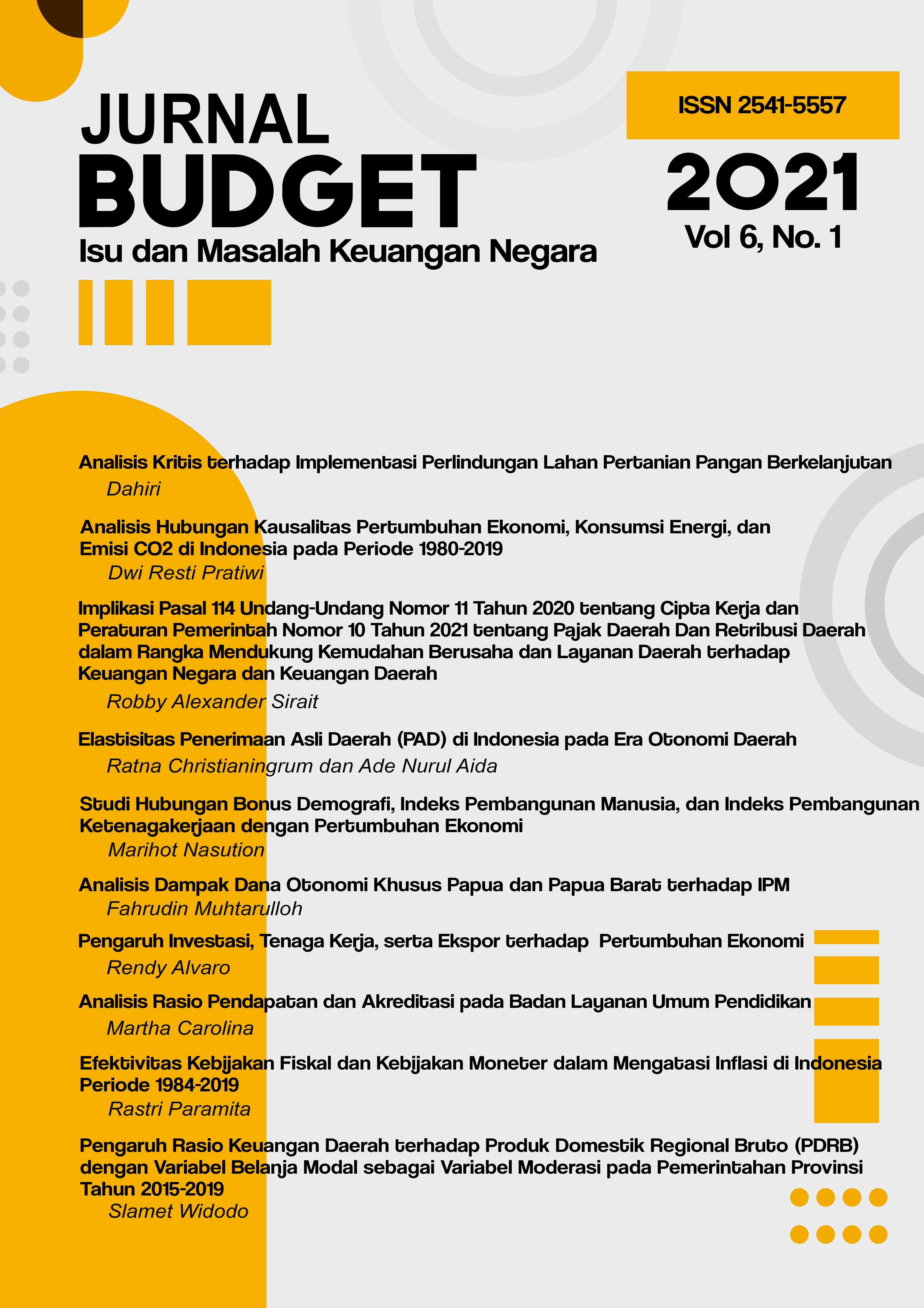
ANALISIS HUBUNGAN KAUSALITAS PERTUMBUHAN EKONOMI, KONSUMSI ENERGI, DAN EMISI CO2 DI INDONESIA PADA PERIODE 1980-2019
DOI:
https://doi.org/10.22212/jbudget.v6i1.67Kata Kunci:
energy consumption, economic growth, CO2 emissionAbstrak
Energy plays an important role in the growth of economic. On the other hand, the
increase of economic growth will also trigger the occurrence of degradation of
environmental quality derived from CO2 emissions. CO2 emissions are caused by
oxidation process of fossil fuel energy. Many studies have attempted to look for
causality between energy consumption, economic growth and CO2 emissions
mainly on developing countries. This study therefore analyze the relationship
between energy use, economic growth, and CO2 emissions in Indonesia during
1980-2019. It applies granger causality methods to examine the relationship
between energy consumption, economic growth, and CO2 emission. The findings
of this study indicate that there is no causality or unidirectional relationship between
energy consumption and economic growth. There is no causal relationship
between economic growth and CO2 emission and there is a unidirectional
relationship from energy consumption to CO2 emission. Based on the result of
analysis, it recommends that the government need to develop energy-efficient
infrastructure, transform low carbon technologies aimed to reduce emissions and
improve the use of renewable energy in all sectors.
Referensi
Apergis, N., Payne, J. E. (2010). The emissions, energy consumption, and growth nexus: Evidence from the commonwealth of independent states. Energy Policy, 38, 650–655.
Ashgar, Zahid. (2008). Energy-GDP Relationship: A Causal Analysis for the Five Countries of South Asia. Applied Econometrics and International Development. Vol. 8 No 1. pp. 167-180.
Budiwan, Isa. (2020). Analisis Pengaruh Konsumsi Energi Terhadap Pertumbuhan Ekonomi Dan Emisi Karbon Dioksida Di Indonesia. Tesis dalam Program Studi Ekonomi Sumberdaya dan Lingkungan. Intitut Pertanian Bogor
Badan Pusat Statistik. (2020). Laju Pertumbuhan Produk Domestik Bruto British Petroleum. 2020. Statistical Review of World Energy.
Chang, C. (2010). A multivariate causality test of carbon dioxide emissions, energy consumption and economic growth in China. Applied Energy, 87, 3533–3537.
Chontanawat, J., Hunt, L., & Pierse, R. (2006). Causality between Energy Consumption and GDP: Evidence from 30 OECD and 78 non-OECD Countries. Survey Energy Economics Discussion Paper Series 113 dalam http://www.seec.surrey.ac.uk.
Dritsaki, Chaido dan Melina Dritsaki (2014). Causal Relationship Between Energy Consumption, Economic Growth and CO2 Emissions: A Dynamic Panel Data Approach. International Journal of Energy Economics and Policy Vol. 4, No. 2, 2014, pp.125-136 ISSN: 2146-4553.
Gujarati, D. N., & Porter, D. C. (2003). Basic econometrics (ed.). Singapore: McGrew Hill Book Co.
Granger, C. W. (1969). Investigating Causal Relations by Econometric Models And Crossspectral Methods. Econometrica: journal of the Econometric Society, 424-438.
Halicioglu, F. (2009). An Econometric Study of CO2 Emissions, Energy Consumption, Income and Foreign Trade in Turkey. Energy Policy. Vol.37. No.3 pp.1156-1164. DOI:10.1016/j.enpol.2008.11.012.
Hwang, Yoo. (2012). Energy Consumption, CO2 Emissions, and Economic Growth: Evidence from Indonesia. Springer Science Business Media (12). 63-73.
Kaika, Dimitra., Efthimios Zervas. (2013). The Environmental Kuznets Curve (EKC) theory Part A: Concept, causes and the CO2 emissions case. Energy Policy. Vol. 62. pp 1392-1402. https://doi.org/10.1016/j.enpol.2013.07.131.
Kementerian ESDM. (2019). Handbook of Energy and Economic Statistics of Indonesia 2010, 2015, 2019.
Lean, H.H., Smyth, R. (2010). CΟ2 Emissions, Electricity Consumption and Output in Asean, Applied Energy. 87(6), 1858-1864
Luukkanen, J. & Kaivo-oja J. (2002). ASEAN Tigers and Sustainability of Energy Use Decomposition Analysis of Energy and CO2 Efficiency Dynamics. Energy Policy. 30, 281-292.
Maddison, D, and K. Rehdanz (2008). Carbon Emissions and Economic Growth: Homogeneous Causality in Heterogeneous Panels. Working Paper No. 1437, Kiel Institute for the World Economy.
Niu, S., Ding, Y., Niu, Y., Li, Y., & Luo, G. (2011). Economic growth, energy conservation and emissions reduction: A comparative analysis based on panel data for 8 Asian-Pacific countries. Energy Policy, 39, 2121–2131.
Omri, A. (2013). CO 2 emissions, energy consumption and economic growth nexus in MENA countries: evidence from simultaneous equations models. Energy economics 40: 657-664.
Osman M, Gachino G, Hoque A. (2016). Electricity Consumption and Economic Growth in the GCC Countries: Panel data analysis. Energy Policy. 23. 318 - 327.
Our World in Data. (2020). CO2 Emission by Fuel Type. Diakses dari https://ourworldindata.org/grapher/co2-bysource?tab=chart&stackMode=absolute&time=2000..latest®ion=World.
Panayotou, T. (1993). Empirical Tests and Policy Analysis of Environmental Degradation at Different Stages of Economic Development.
Pao, H., Tsai, C. (2011). Modeling and forecasting the CO2emissions, energy consumption, and economic growth in Brazil. Energy, 36, 2450–2458.
Putra, Serdo Nurdi Dan Alpon Satrianto. (2019). Analisis Hubungan Kausalitas Penggunaan Energi, Pertumbuhan Ekonomi Dan Emisi Lingkungan di Indonesia. Jurnal Ekonomi Dan Pembangunan, Volume 1, Nomor 1, Februari
, Hal 49-68. Fakultas Ekonomi Universitas Negeri Padang.
Stern, David. (2003). Energy and Economics Growth. Encyclopedia of Energy. Volume 2. Elsavier Inc.
Soytas, U., & Sari, R. (2009). Energy consumption, economic growth, and carbon emissions: Challenges faced by an EU candidate member. Ecological Economics, 68, 1667–1675.
Susanto, Joko dan Dwi Hari Laksana. (2013). Uji Kausalitas antara Konsumsi Energi dan Pertumbuhan Ekonomi di ASEAN. Buletin Ekonomi Vol 11, No.1 April 2013 Hal 1-86.
World Bank. (2020). World Development Indicators: GDP Constant 2010.
Zaekhan. (2012). Dampak GDP per Kapita dan Energi Terbarukan pada Emisi Karbondioksida Negara G-20. Depok: Program Pascasarjana Ilmu Ekonomi, Fakultas Ekonomi UI.
Unduhan
Diterbitkan
Cara Mengutip
Terbitan
Bagian
Lisensi
Hak Cipta (c) 2021 Dwi Resti Pratiwi

Artikel ini berlisensiCreative Commons Attribution-NonCommercial-ShareAlike 4.0 International License.
Jurnal Budget is licensed under a Creative Commons Attribution-NonCommercial-ShareAlike 4.0 International License. Permissions beyond the scope of this license may be available at https://ejurnal.dpr.go.id/index.php/jurnalbudget/index.

 Pernyataan Etika